Thanks for visiting my blog, you can join me by subscribing
Showing posts with label Eclectic Education Series. Show all posts

Saturday, May 18, 2013

Creating answer key booklets for the Ray's Arithmetic series


I am very thankful for this "electronic age," which I believe God is using as a great blessing around the world. But I still tend to be very much the "analogue" in many ways!

It is still hard for me to do any serious reading and studying from a screen, so I prefer 3-D books that I can hold. This is why I spend the time to print out and bind books from the past. 

As our children have been using the Ray's Arithmetic Series for their math, we have found it quite inconvenient to have the text printed, but the answers still in their digital form.
This is why I chose to print the answers out separately, create covers, and then staple them into booklets. The Dollar Homeschool discs have made this all so simple because the answers are separated into separate files. 


Here is how I create the covers for these booklets:

I first select the title page of the book and copy it. Then I paste it onto a Microsoft Publisher (there are similar programs that are open-source and therefore free, such as scribus) page, with a landscape orientation, making sure that the cover material will fit neatly on the right half of the page. I like to put a text box with the words "Key to" somewhere above the title page. 

I also like to use a border from Clipart Etc. (you can find these under the "design" section). Here are some links to ones I have used:


I arrange the two pages so that the title page fits neatly inside the border, then I print my composition out onto card stock. 

I print the answers out two-pages-per-sheet, and two-sided, then I stack these pages on top of the cover I created and staple them all in the middle with my long-arm stapler (this tool was worth every penny I paid!).

I keep the booklets in my special "teacher's drawer" for easy access for both the children and myself. 

Sunday, April 21, 2013

Irregular Learning


A walk around the pond
I am really enjoying what we are doing for school. The children are learning so much, and I can see their progress.

The ones who are just beginning are already showing areas that are their strengths, and others that are their current weaknesses, but I am not concerned. I have learned that, just because I child is struggling in the area of reading or math at the age of six, doesn't mean that he/she will be struggling forever! I am a firm believer that many "learning disabilities" disappear as children mature.

Of course, some of us simply are weak in certain areas, and this can take some acceptance. The idea is to strike a balance between what we should expect and challenge our children to do, and what they are actually capable of doing.


The middle girls are both growing greatly. They are doing well in their McGuffey's, and they are moving steadily forward with their Ray's Arithmetics, both in different places in the Elementary book. The story problems can sometimes be a little difficult, but that is when we get out the chalkboard and make pictures.


Questions about math
Besides their regular work, these girls read voraciously, and one has decided to do a number of lessons in Long's Language each week, and she loves memorizing the little poetry as she is directed, etc. The other has been working through a writing curriculum from 7 Sisters which I won as a prize through the Homeschooling Blog Awards. She already gobbled her way through the poetry section, totally on her own, and now is zipping through the short story portion--and loving every minute! She definitely has the writing bug.

The older children have a great time with the McGuffey's and Ray's, the daughter of the two really, really loves McGuffey--she would do four lessons a day if we had the time. She not only likes to do the lessons, but she likes to share what she is discovering through them with all of us. She is very quick, and she loves to decorate the pages as she does her work in her copybook. Ray's is her favorite, though, and she would probably do that all day--she is always asking for more time to do it! She also excels in domestic skills, is learning to create a pattern on her own and sew her own clothes, has been doing little stitchery works, and will be baby-sitting her niece once-a-week. She is hoping to learn DSLR photography and put her photos on her blog.


Long's Language work
The son of the two is so full of artistic creativity--and yet he can also be technical. I hate to hamper him in any way, but I have to help him by goading him a bit now-and-again and making him do his lessons (well). He is sweet about it, though, and sees the wisdom of it himself. He can sometimes feel as though his creativity makes his mind wander from one wonderful thought to another in rapid succession, so I am trying to help him to learn how to discipline his gifts (the spirit of the Prophet is subject to the prophet).  He is working on learning to use the Adobe creative suite, and his handiwork is fantastic! Perhaps someday he will be selling them through our website, one that he is currently working on with much fervor so that we can launch it soon. Probably then this blog will end up there...

Meanwhile, both are also  reading, the Creative is often found with his nose in something from J.R.R. Tolkien (he wrote more than just the ring trilogy and The Hobbit) and the Dear Young Lady is searching for something to follow up after reading all of the popular classics.

Together we have finished a concentrated study of the etymology of the English language, fascinating and one which has enabled the children to have a better grasp of vocabulary, grammar, even spelling, with a greater appreciation as to how our Bible came to us. Of course, we studied all of this because I found it so fascinating, and the children caught my enthusiasm!

Sarah sewing
Our current studies together include an overview of all punctuation (I repeat this study periodically, using different methods, etc. to reinforce their own studies) and have daily short dictation exercises.
I have also begun to cover all sorts of very practical areas of living in greater detail, such as our current study of microbiology and keeping our homes and our lives healthy. I am planning on covering all sorts of growing-up skills, such as caring for clothing, nutrition and cooking, etc. I am taking these subjects on because I have often assumed that they just "know" because I have learned about these different areas and become skilled in homemaking slowly over many years, and I forget that this is a new group that needs to be taught and led more specifically.

Of course, I am enjoying each subject, even each part of each subject. Whenever I get feeling pressured, my loved ones will suggest that I put our little learning sessions aside for a time. What they don't realize is that I would gladly give up a lot of other things, but our learning times are the best parts of my day! My oldest daughter, who also home-schools her children, feels very much the same! 

Thursday, March 28, 2013

How You Can Teach Your Children Reading with the Revised McGuffey Readers


One room school-house

Someone on the CMOMB (Christian Moms of Many Blessings) message group recently asked me to give some examples of how a typical schedule or routine of someone using the revised McGuffey series could look like, so I thought I would post a few ideas here so that others might gain some insight from them as well.

Here is how we typically go about things:

Each child is assigned a McGuffey's Reader. I have chosen these, not only according to their reading abilities, but their writing, spelling and grammar abilities as well. Some of my children are actually reading a bit better than their McGuffey's level, but are not as confident when they are creating original sentences, etc.

I do not feel strange about starting a child in the middle of a reader, if that is his/her level.

Those that are at the middle of the second  reader level and above are required to read their lessons to themselves. Next, they are required to copy one paragraph from a prose lesson, and each lesson that includes poetry in its entirety (very often these will not include words lists, hence the extra work). They also must write the gist of the lesson in their own words (narration). When all of these tasks are completed, I might ask them to extend their lessons by creating a notebooking page suggested by a subject from their lesson, such as a biography of the author or a page on a bird mentioned in a poem, etc. (when they complete these assignments they are to hand their work to me and I then go over them for neatness, accuracy, interest, and correctness).


While these older children are working independently, I take time with the pre-readers. I try and keep their lessons as short and sweet as possible, and we usually sit on a couch together and snuggle a bit. This is precious time that I really enjoy.

I like to use the alphabets printed at the beginning of the Primer and the 1st reader for some general practice, just to get my youngster familiar with all of the symbols and what they are supposed to do for us. I might sing the "ABC Song" while I touch each letter, then hold her finger and help her to touch each letter while we sing together. I might continue this practice off-and-on for many days, or even weeks if the child is very immature.

A sample of my flashcards

I also love to introduce the sounds of each letter using phonics flash cards ( I have created my own set, which can be bought along with my entire guide for a minimal fee, downloaded and printed on card stock). At first I will use the whole deck and rely on the pictures to add clues as to the sound of each letter, but after a time I will cover up the pictures and concentrate on about four of these at a time until they are mastered.  Also during this time I might play "find it" with the different alphabet symbols on the first pages of the Primer.

Also, especially with those who are very new to reading, I will go over at least the first few lessons in Teach Your Child to Read in 100 Easy Lessons. This usually breaks them into the idea of "sounding out." But I have also learned over the years that total reliance on sounding out each and every word is not only cumbersome, but it is also unnatural. Most of us sound out some, anticipate (make a guess based on context) some, and memorize some of the words when we are beginning to read. I allow the use of all these three strategies when I am teaching a beginner.

This is how a typical week might look:
Day one--sing the alphabet song while pointing to the letters. Have the tiny one sing with me as I point.

Day two--repeat the same lesson--keep it short but fun.

Day three--the same, only this time ask if the tiny one would like to sing along.

Day four--this time we are both singing, and I am helping my child point to each word.

Repeat the same for a few more days.

Day ten or so--take out the phonics flash cards and lay them all on the floor in a "train" fashion. Walk along the train and sing the ABC song. Have the child pick up the cards as you sing the name.

Day 11--lay the cards out in a train, only this time call out the name of a letter and have the child pick it up and hand it to you.
Play this game for a few more days.
Day 13--Begin to use the flash cards to practice the sounds. You can use or omit the "ch," "sh" and "th" cards as you wish.
* If you are not well-acquainted with the sounds yourself, try watching this series of videos with your child from Super Simple Songs (there is one instance of a which on a broom, so be prepared to explain). 
Days 13 through 20--continue to use the flash cards each of these days. This may sound too simple, but the simple repetition of this exercise in its consistency will help the child more than drills that take an excessive amount of time and tend to burn you both out.
Of course, throughout this process have your child color with color crayons, paint, sculpt with play dough, cut with scissors, etc. so that she can build the skills necessary to eventually be able to write, which makes reading fun, too.

Here it may be good to insert a few lessons, I would try and go through at least until lesson 10, from the Teach Your Child to Read in 100 Easy Lessons book.

* A word of caution here; not all children are automatically ready to take the next step. Some, especially boys, are just not capable of processing for reading yet. Don't push if you sense a lot of resistance, or if he/she does not seem to be able to remember sounds and words from one day to the next. The best remedy for this is not "therapy," but time! You can either give the child a break for a few months, or continue with your simple lessons until he/she is more mature (be careful not to leave a bitter taste in your child's mouth through prodding and scolding, or you might be postponing reading for longer than you realize--keep things light and happy and trust God).

If your child is eager and capable, then it is time to continue with the first lesson in the Primer.

First, take time to examine the book together. Discuss how it is bound, how old it is, how nice the pictures are, etc. Show her how the lessons are set up.


The first lesson is about a rat, which is a common creature which can be fascinating, distasteful or even scary to some children. Nevertheless, it is an easy word to understand. Take time to go over each of the sound presented. If you have used the "100 Lessons" book mentioned earlier, these sounds should not be foreign at all.

For the first days, I would read the letter sounds and the words while pointing to them in front of the child. At the second or third day, I would have the child read them after me. On about the fourth day, I would expect the child to be able to pick out the different sounds or words as I called them out.

I would also have a chalkboard or whiteboard handy, on which we could practice drawing rats and the child could watch me write the letters and the words as I said them. She should also be given the opportunity to practice these things on the board for herself. This is a method that was highly recommended in the McGuffey's teachers manuals I found on the Dollar Homeschool collection for the EES.

On the fourth day, I would have the child attempt to read the lesson for him/herself, with help, of course.

To keep things fresh, I would then move on to the next lesson, and proceed much in the same fashion as for the first lesson.

As the lessons progress, I would encourage lively discussions about the illustrations. Language arts is about communicating with language, and oral expression is one of the ways we communicate with each other. Instead of asking questions such as, "Do you like this picture," I would ask questions like, "What are the children in this picture doing?" and, "What do you think will happen next?"

Having the child create a notebooking page with their own drawing of the illustration in the book and a few letters underneath may be another way to reinforce what is being learned. 

* When you come to the review lesson V, you may notice some cursive writing at the bottom of the page. This is included because children were taught to write in cursive script from the very beginning. There are those that still swear by it, but we must keep in mind that most of the students of the past did not enter formal schooling until the ages of seven or eight. The find motor control necessary to produce script might be beyond most 5-7 year-old of today. However, it may be of great benefit to your child to teach him/her how to read simple script from the beginning, and if a child wanted to practice copying such writing you could definitely help him/her. 

It is very important to keep in mind that mastery is more important than progress. In other words, if a child is having difficulty with a lesson, it is better to take the time to master that lesson than to move on. Keeping the lessons short and sweet will help you to keep the frustration level down for both of you. Don't fall into the temptation to "drill 'til you drop"--this can prove disastrous! Don't let your pride or frustration get in the way of ministering to your child's heart.

I hope this helps, and I hope that it will give someone a leg-up. I have gleaned these ideas mostly from my own experience teaching 13 of my children to read so far (two more to go!).

If you are interested in finding out more, you can purchase my book, Homeschool Sanity, and/or go to my other blog, Large Family Mothering. 

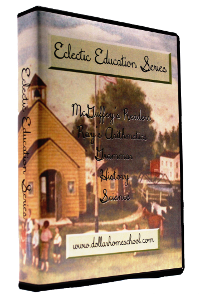
The McGuffey readers and more can be found on DVD from Dollar Homeschool.
 

Monday, February 18, 2013

Using Ray's for Beginning Math

Mother teaches oral lessons
When one compares the primary Ray's Arithmetic with newer curricula, there seems to be a lot missing! The copy I am holding in my hand is only 94 pages long, which pales in comparison with modern books that cover the same material.

What is more incredible is that this tiny volume was meant to be used for two years!

So what is a modern teacher to do?

Here is a general course of action, as recommended in The Manual of Methods, which was written as a guide for the Eclectic Series (of which Ray's was a part):

  • Don't allow the children to use the book or to write at all at the beginning.
  • Use common objects, without using the number symbols.
Do not teach the figures in the first lessons, and do not allow the children to do any written work; but teach orally, illustrating every operation, at first, by means of various objects. Manual of methods, page 107
  • Practice counting common objects, then grouping them and having the children recognize them in groups without counting, such as seeing 3 blocks, 3 balls, 3 spoons, etc. Children should become able to recognize groups of up to 10 objects without counting them.
  • Show children how to group and re-group within a certain number, so that it will seem natural to think of, say, 5 as being 2 and 3, 4 and 1, etc. Also do the reverse actions, such as realizing that 5 take-away 3 leaves 2, and so on.
The instruction should be entirely oral, and should deal altogether at first with concrete numbers. The little child cannot grasp abstract ideas. It is true you can teach him to repeat, "2 and 2 are 4;" "2 from 4 leave 2:" "2 times 2 are 4;" and "4 divided by 2 equal 2." But, without the proper preliminary work, these words can not possibly convey any clear meaning to his mind. This kind of instruction in a primary class is simply machine drilling on abstract numbers and words which convey no ideas, or at best a mere jumble of ideas to the child's mind. It is one of the worst, and at the same time one of the most common, faults in the teaching of arithmetic, and it is one which is very apt to disgust pupils with the subject from the outset. On the other hand, if the proper method of teaching is pursued, which may properly be called the object method, the children are taught to think; they will be interested at the very beginning, and they will be kept interested by this method until they are successfully carried to the point where the object method is no longer necessary, and their minds are ready to grasp the abstract, through careful preliminary drill on the concrete. Manual of Methods, pages 107-108

I have created flash cards in my Ray's Helps that illustrate these principles, one set without numbers, the other one with numbers, that can be printed out and used to aid a parent in this endeavor.

  • Then, and only then, begin to introduce the actual number symbols.
Teach the concrete digital numbers in regular order, from one to ten inclusive, illustrating each number by corresponding groups of objects. Manual of Methods, page 108.
It is important to realize that there are only ten written digits, and that these ten alone make up our whole number system! If we can approach this task from this perspective, things become a little more clear to our minds, and we can encourage our children that math is not that difficult, after all!

This beginning, if done in increments of only 10-15 minutes a day, should cover a number of months!

This is not complicated, not dreary, not time-consuming. My suggestion is to take a small basket and fill it with what you will need--some counters, which could be marbles, beans, pasta shapes, etc., and some flash cards. Eventually a small chalk or wipe-off board could be added, as objects and numbers are drawn, and then the child may draw objects, circle things, and eventually begin to write the numbers. 

Remember, this method was formulated for the one-room schoolhouse. A teacher in such a setting had to manage the education of a number of students in various stages of learning. I have read over and over that the Ray's method is extremely "labor intensive," but I have found the opposite to be true. Of course, if one is expecting a child to be able to grab a workbook and study without any help whatsoever, then this will not fit the bill--but I have yet to meet a child that did not require any instruction whatsoever! But Ray's only takes 15- 20 minutes a day, especially in the beginning years. For a very busy mother, this could be carried out just before bedtime, if necessary! Think of working for 15 minutes on counting, etc., then reading a nice story, saying a prayer, and kissing your babe goodnight! That is it--no muss, no fuss! And, for the real secret, as you are teaching your eldest child, the other tiny ones can be included, meaning that you will have less work to do as you go along... 

Even the next stage should not become a burden.

After a child has become very confident in the above described knowledge, two things should then happen. First, a 100 numbers board should be introduced. This is such a great tool! You can find numerous of these to print out for free on the Internet, the most frequented being the Donna Young site. You should have on printed out and either laminated or placed in a plastic protective sheet. Then the fun begins!

There are so many things that can be done with such a chart that I have collected some sites that list them:

20+ Things to Do With a Hundreds Chart

The Wonders of the Number Chart

A hundred chart looks deceptively simple, but complex understandings can be developed by using one. On it children can learn to count, and to consider prime numbers, and everything in between. Use the chart often enough that children will carry its image in their minds for years--for as long as they need it, which may be a lifetime or at leas until they are so far into abstract thinking that they don't need the image anymore. Ruth Beechick, You Can Teach Your Child Successfully, Mott Media
Begin with simply counting to ten for a few days if necessary, then quizzing the student and having him find a number as you call it out. Do the same to 20, then by 10's, then to 100. After this is mastered, you are ready to introduce a number of the other fun games.

As you are exploring this avenue, then begin to work through the text. There is a bit of confusion here concerning the first lessons. It needs to be understood that formal math instruction was not begun in most schools during this time until a child was already reading--in fact, math was often delayed until the ages of 9 or 10. If you are working with a pre-reader, or a struggling reader, then you might want to skip to lesson V and VI, and proceed from there. 

Lessons VII-IX are good just as an initiation. Lessons X-XX could be done in this way; read through the math facts and the lesson, asking questions and, if necessary, using objects to illustrate the different principles. Each day afterwards, read the facts out loud and have the child repeat them. After a number of days, ask the child to recite them from memory, helping at first. When mastery is achieved, go over the questions in the text once more. Lessons XXI and XXII are good for extra practice in mental exercise and review of the previous facts learned. These review lessons could take a number of days--no need to hurry through them!

In this same way, the first 37 lessons can be covered. This is meant to be the first entire year of study!
...for more excellent results, you should faithfully follow the mental system in Ray's Arithmetics. Avoid the temptation to hurry the children into writing rows and rows of problems so you can put them to work and take a recess. many children are better off not starting formal arithmetic study quite so early as our society tends to think. So, particularly in a home school setting or small one-room school, you can use real-life situations, manipulative objects, and games to help children develop in their understanding of numbers. Relax and take things at the children's pace. Ruth Beechick, from the Parent-Teacher Guide for Ray's New Arithmetics, published by Mott Media.
Feel free to have fun with all sorts of games, flash cards, etc. You are building a foundation here that will help your child, not only to master math, but to enjoy it!

Of course, for fun and reinforcement, other things can be added. We like the Rod and Staff  books for coloring and counting fun, as well as other practice. Each workbook is only $2.95, which is very reasonable.

After Ray's Primary Arithmetic is completed, then it is best to move on to Ray's Intellectual, but that is for another post, since this one was to answer questions about beginners!

Here are the wonderful ways to obtain your own copy of this wonderful book: 

Dollar Homeschool. This is a collection of all of the Eclectic Series textbooks, including Ray's and all of its complimentary resources, such as teacher's manuals, etc. which have been scanned in and put on DVD. Having all of these delightful works together in one place was so helpful that I just had to write guides so that others could enjoy them, and these guides are now included! 

Mott Media. These folks have reproduced hard-bound copies of the original McGuffey's and the "new" Ray's, and also offer guides written by Ruth Beechick along with consumable workbooks to go along with the series (which I have never used).

There are others which offer hard-copies of the McGuffey's, usually the revised series (1880 or so). Amazon is also a great source.

Of course, there are numerous ways to obtain these books online for free, and Internet Archive is the fastest way I know of to find all sources at once.

I would also strongly suggest reading Ruth Beechick's guides on teaching at the elementary stage, as are listed on the Mott Media site.


Above is a poster page that will serve as a reminder of the ideas suggested in this post. Just click and save the image to your computer, perhaps pasting it into a word-type page and printing it out. 


Friday, January 4, 2013

Mommy's Toolbox--Things to Consider When Turning the Corner in Your Home-schooling!


A major planning slump!
It's the beginning of a new year--a time when countless home-schooling mothers seem to experience a major planning slump in the months between Christmas and spring-time, especially with those mothers who are home-schooling for the very first time!

We may feel a bit unsure because:


  • Our children are not cooperating.
  • The curriculum we chose doesn't seem to be working.
  • The relatives (and/or friends) are really negative.
  • Our life and/or home is in such disarray that we can't get "school" done.
  • We aren't sure we can handle 12 years of this!
  • Financial circumstances are adding to the difficulty and pressure of the situation.

Here are some ideas that have helped me to get "over the hump" during the past 25 years. 

1. Don't give your children too much too soon. I read recently about a young mother who wanted to begin officially homeschooling her little girl before she had even reached the tender age of two-years-old! In my humble opinion, bright toddlers are like "little learning machines," they rarely lack the energy or enthusiasm necessary for discovering and enjoying new things!

The trick is to tap into their natural inclinations. A good initial step would be to keep a toddler's environment free from empty-brained "time wasters," such as the new gadgets for babies that are supposed to mimic iPhones, iPads, and the like. Small children will learn best in an environment that facilitates and encourages open-ended play, such as with blocks, dolls, a sand-box, Legos, etc. Fortunately, these types of play-areas and toys are easy to come by, and are not too expensive.

Three other important parts of a good preschool curriculum are: 1) responding in a warm and supportive manner to questions, 2) reading books aloud, and 3) including your child in day-to-day life experiences.

To many this is a natural part of the nurturing that is essential to teaching your children at home. 

What is next?
2. Don't be afraid to drop something that is either too advanced or too tedious. If your children don't like the curricula or methods that you are using that's one thing, it's another thing if you dread using them yourself! 

No matter how colorful, glossy or high-tech a program may seem, it could be the very worst thing for you and your family. 

The kind of learning that makes a lasting difference in a person's life is not the canned-type that must be driven by teachers and other authorities. Schools don't understand this, of course, and this is primarily why they are forced to use advertising gimmicks to keep the attention of students. This is the reason why much of the curriculum materials are so colorful and filled with graphics, but even the best window-dressing in the world will not hide the blandness that lurks beneath, and savvy young scholars can sniff out demagoguery a mile away!

The learning that sticks is so interesting on its own merits that your children won't have to be prodded to use it. You will quickly discover that your kids will sneak it into their bedrooms, and hide under their covers to read about it after bedtime. They will be so engaged with it that they will want to spend every waking hour in its pursuit because it is "delight-driven" learning. 

I know it is hard to give up on something that you have spent a lot of money for, and it is a bit hard on one's pride to admit to making a wrong choice, but the alternative is just too detrimental to consider not correcting the mistake! 

Do yourself and your kids a favor and let it go.

(We have chosen to use McGuffey's Readers, Ray's Arithmetics and Spencerian Penmanship, etc. because these cover the basic academic subjects and leave loads of room for other topical subject matter to be learned in more natural ways) 

3. Get some encouragement and moral support from someone who has been where you are now. Keep in mind that home-schooling is still counter-cultural today. When a parent chooses to educate their children at "home," there may be some folks who feel uncomfortable with your decision to do so. The grandparents are worried about how their grandchildren will get along in the world, both friends and some relatives may automatically assume that they are being judged by your unconventional choices, it's simply human nature.  


Be sure that you become grounded in your decision to home-school, so that you will be able to intelligently communicate the why's and wherefore's of what you believe. Have you ever noticed that those who are very confident hardly ever spend time defending themselves, while those who are secretly unsure are the ones who are the most vociferous and adamant? More often than not, they are, in reality, the ones that are filled with unfounded doubts and are easily influenced.

Why are you homeschooling? It is important for you to examine your true motives, because the foundations will determine whether you will be building your home-school with a "house of cards" or on "solid-rock." 

Read some good books, not only about how awful public schooling is, but also about how wonderful true learning can be, and even what true learning is. Take some notes, talk to some people, read some testimonies, make some friends; pray, pray, pray. It is likely that you will come out of such a time of soul-searching stronger than ever before, and you will be able to look past the voices that were once a torment and be able to show unconditional love to those people in spite of themselves! 

4. Get a handle on the small and disorganized things in your life. Are the children unruly?--take some time and energy to get them back into line. Is the current condition of your house in disarray--roll up your shirt-sleeves and get your house in order and then learn how to make it run more smoothly. Get the social media in your home under control, have some sort of routine in place, and become self-disciplined. You know, order adds to our lives, it doesn't detract. Good habits benefit us, but bad habits will enslave us. 

Just imagine how wonderful it would be to not have to waste hours searching for a pair of scissors, a pen, or a hammer when you are hanging a picture. It would be so great to know ahead of schedule what you are having for supper, or that your children will be wearing clean clothes. All of these things take planning and diligence, but having a place for everything and everything in its place will pay you back in dividends! 

5. Learn to take things one-day-at-a-time. In some ways, the choice to public school ones children can give a parent a lot of security; there is an expected course with an expected end, hopefully a college education and as a result a successful life (provided you agree with and are willing to submit your children to their agenda, curriculum, amoral approach and resulting statistical record of failure). 

We are not all the same!
But we human beings have a way of thwarting "the best laid plans." Try as we might, we simply can not squeeze every child into the same mold in the elusive hope that by so doing we will alleviate all of our problems! Students are often unwilling, or even unable, to follow the expected course. They don't always finish the reading assignment on time, or perhaps they can't grasp abstract mathematics, and sometimes may have difficulty concentrating, or get easily bored, and have behavior problems as a result. People are individuals and not machines; they are living and unique spirit-beings, and the God who is there and is in charge is not interested in factory-produced automatons.

Don't live in the future, but allow His plans to unfold before you. If you submit to His perfect will, live to please Him and teach your children to do the same, you will be amazed at how He will be able to work even the worst of things together for your good. (Romans 8:28) 

6. Tighten up, simplify, and learn to live a faithful and thankful, praise-filled life. Learn to make do with little, and God will make you worthy of much, either in this life or in the life which is to come! Money has been tight for us for most of our home-schooling experience. During our 30 years of marriage we have predominately lived from month-to-month, often having to rob Peter to pay Paul. I have had to learn to fix my own hair, give the boys haircuts, sew clothes, alter and repair second-hand clothing, make rice and beans a staple part of our diet, and drastically limit restaurant visits. Nevertheless, with this "deprivation" we have discovered the richness of a life of simplicity and thanksgiving, and the bounty of trusting a loving and merciful God who provides for all of our needs.
Above all, remember, walking in obedience to God is the best way to live a peaceful, and hope-filled life, because He holds our future and we can leave all the consequences up to Him.


When we walk with the Lord in the light of His Word,
What a glory He sheds on our way!

While we do His good will, He abides with us still,
And with all who will trust and obey.

Trust and obey, for there’s no other way
To be happy in Jesus, but to trust and obey.


Wednesday, December 26, 2012

"Cheating" in order to learn


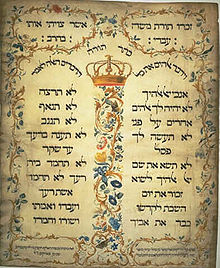
God's Holy Commandments
There is a type of cheating that breaks God's law; it is stealing, lying, and coveting. This is done when we look at someone else's answers during a test, or reproduce someone else's work and hand it in as if it were our own, or when we plagiarize a writing assignment.

But there is another kind of "cheating" that isn't cheating at all; it's just an alternative way to learn, or to beat the "system."

For instance, I have often been stuck without a clue while working on a math problem, and peeking at the answers at the back of the book helped put me on the right track. This is not only allowable, this is expected, which is why textbook publishers have the even (or odd) answers included in the back. Most teachers expect students to show their work anyway, so it is really impossible to do anything unethical.

Working on a math problem
Since we enjoy using the Ray's Arithmetics on the discs from Dollar Homeschool, I've printed out the answers into helpful booklets and handed them out to my children--then they are free to look lessons up in order to to see if they understand what is being asked of them, or precisely how a problem should be solved, just as long as they know that they must show all of their own work.

There is another way to "cheat" that is often very beneficial; this is when one is supposed to read through a chapter of information and afterwards answer a series of questions in order to confirm comprehension of the material. The content of the reading assignment is usually the most important in the chapter, and the type that would most certainly be on a test. Now, if a person is extremely interested in the course of study, then he or she would probably want to read the chapter very carefully, and even follow up with a bit of additional research, but, unfortunately, most texts theses days are pretty dry, and the information they contain may be either irrelevant, slanted, or obvious propaganda. In such cases as these, a person just wants to grab the most pertinent data without clouding his or her mind with a lot of nonsense.

This is when the index becomes a student's best friend! By taking a key-word from the question and using it to look up the specific page, often the specific paragraph, in which it is contained, an accurate answer can be formulated. This is a great time-saver, and, especially when the class is required but is also full of a lot of hogwash, this saves brain-space for more important things!

Discovering the proper solution to a problem
Now, I have never used the "regurgitation" method of learning in my homeschool (reading a section and then answering several "canned" questions, or some fill-in-the-blanks, etc.) for about 20 years. In certain ways, this may leave my precious children more vulnerable, since they have never undertaken a subject that, for them, was not either vital or interesting to them, and so they have a tendency to take everything put before them very seriously. But they will need to learn specifically how to use this strategy whenever they are forced to take one of these courses, so I teach them how to perform well while hardly being influenced.

Regurgitation, as I call it, is one of the worst ways to really learn anything. It actually does very little for real retention at all, and is more about memorizing mere facts than in communicating important ideas that a student can then internalize so as to make a lasting impression on his or her reservoir of true and beneficial knowledge.

For instance, I might be able to rattle off the exact dates of the beginning of the Revolutionary War and some of the names of the major persons involved, but I might miss the actual reasons for the war, or the larger implications for mankind, or how the attitudes and ideals of the Founding Fathers could or should affect me in my thinking today. And even if I was made to memorize a statement or two concerning the reasons and effects, it would make very little difference if I was not able to think them through for myself and connect them with other lessons of history or the way I look at my life.

Besides, there are so many angles from which to view any event in history. There are often many different ways to answer even the most basic question of why something happened. Was the Civil War fought exclusively over the issue of slavery?--not hardly! 

A few of our own notebooking pages
Students need to have the opportunity to interpret and analyze the facts in their own way, from their own perspective. This is why the Charlotte Mason method of narration is so much superior to that of simply getting the answers to some "canned" questions. Of course, there are quite a number of different styles of "narration" for any lesson, chapter, book or subject. With my creative and resourceful children, we like not only to write, but to illustrate, act-out, or in some manner display what we are learning. Notebooking is one of the terrific vehicles for this, but there are many others.

What are some of the alternatives that you have found?

Tuesday, January 10, 2012

Do you sleep?

Does a mother need to be told she needs sleep?--sometimes we all do. Especially when we get a real case of "do-itis".

I found this wonderful sage advice while printing out the 4th reader of the Alternate McGuffey readers from Dollar Homeschool.


Lesson 43--Necessity of Sleep
If you are to work well, you must sleep well. If you are to keep your health, and strength, and youth--to carry your powers of work with you to the last--you must sedulously pay court to your pillow. It will commonly be found that the men who carry their years lightly are men who possess the faculty of sleeping at will.
If you have much work to do, you must not account time spent in sleep to be time lost. It is time gained. It is an essential part of the duty of the day. I had once and old servant who used to say, "Well, I have done my work--now I'll get my sleeping done." Sleeping was, in her philosophy, a thing to be done--not in a passive state, but as an active part of her duty.
And every workman should so consider it. Let him sleep in his bed, if he can, at proper hours of the night; if not, let him sleep at any odd time, when nature invites him to rest himself. If we do not play tricks with ourselves, if we work hard without overworking ourselves, sleep will rarely be coy to us; we can sleep in almost any place. 
As a general rule, it may be said that busy men are better sleepers than idlers, and that mental labor contributes more to sound sleep than bodily fatigue. I believe that only mere novices in work are kept awake by the thought of it. 
Experienced workmen acquire a habit of shaking off its thoughts when they will. If there is one thing in life for which I am profoundly thankful to the Giver of all good, it is for the gift of sleep. 
I have found this advice to be so very true! I have developed a habit over the last 25 years of taking a rest in the afternoons. This is so very important when dealing with the sorts things I must in my home, raising my 15 children. I am to be on call at any moment throughout the day--whether from my dear husband or from an infant child. This means constant alertness and diligence. Rarely do I allow my guard to be down--even on weekends or during times of vacation.

My race is one more one of the marathon--I must space my energy out in order to last and finish. This is why a daily time is necessary where I can put it all out of my mind--just as the writer above suggests.

I wasn't able to block out all of the other thoughts when I first began, but I also incorporated a daily Bible reading just before I went to sleep, and this caused me to gaze upward and place my cares on God, so that my rest was peaceful and I fell asleep quickly afterwards.

I have found that even 30 minutes of this sort of sleep will cause me to be cheerful and life-giving to my family until I go to bed at night--and then, even though my sleep may be interrupted due to various needs on the part of my children, I am still able to feel rested and on top of things.

During those months just after bringing home a newborn infant, I have also learned to sleep pretty much anywhere, at any time, in any position. This ability has been such a great help to me. In those times, whenever the baby is nursing and contented at my breast, and the children are all safely engaged in front of me, I have often snatched a few winks--this was to keep my sanity.

Afraid to take an afternoon nap because of all that has to be done? Consider these words:
"Except the LORD build the house, they labour in vain that build it: except the LORD keep the city, the watchman waketh but in vain. It is vain for you to rise up early, to sit up late, to eat the bread of sorrows: for so he giveth his beloved sleep." (Psalm 127:1-2)