Thanks for visiting my blog, you can join me by subscribing
Showing posts with label The McGuffey era. Show all posts

Thursday, May 9, 2013

McGuffey and the Christian age of America


There are reasons that we find the McGuffey readers so refreshingly moral. They were written in an age of incredible spiritual awakening in America. Here is an excerpt from the site Religion and the Founding of the American Republic:


The religion of the new American republic was evangelicalism, which, between 1800 and the Civil War, was the "grand absorbing theme" of American religious life. During some years in the first half of the nineteenth century, revivals (through which evangelicalism found expression) occurred so often that religious publications that specialized in tracking them lost count. In 1827, for example, one journal exulted that "revivals, we rejoice to say, are becoming too numerous in our country to admit of being generally mentioned in our Record." During the years between the inaugurations of Thomas Jefferson and Abraham Lincoln, historians see "evangelicalism emerging as a kind of national church or national religion." The leaders and ordinary members of the "evangelical empire" of the nineteenth century were American patriots who subscribed to the views of the Founders that religion was a "necessary spring" for republican government; they believed, as a preacher in 1826 asserted, that there was "an association between Religion and Patriotism." Converting their fellow citizens to Christianity was, for them, an act that simultaneously saved souls and saved the republic. The American Home Missionary Society assured its supporters in 1826 that "we are doing the work of patriotism no less than Christianity." With the disappearance of efforts by government to create morality in the body politic (symbolized by the termination in 1833 of Massachusetts' tax support for churches) evangelical, benevolent societies assumed that role, bringing about what today might be called the privatization of the responsibility for forming a virtuous citizenry.

When researching the McGuffey's on line, I came across a lot of negative opinions, accusing them of being "bigoted" and misogynistic. Nothing could be farther from the truth. In fact, the morality of all of the different versions points towards kindness and fairness, without exception for gender, race, or creed. All of these virtues were being sought after in the climate of revivals during the 19th century. These books were not written to impress university elitists and educational demagogues; they were meant to appeal to pastors and parents who wanted to pass their faith on to the next generation. Unlike education today, curriculum decisions were left at the local, even the home, level. I wonder how curricula would be chosen today if the same were true!

Sunday, May 5, 2013

One-Room School


We have a lot of trouble with the library--I have called checking out books my one acceptable "vice" for many years.

When the children were younger we would check out maybe sixty books at a shot, then something would happen and I would let those books be a few days overdue and...well you can imagine the fines!

One day my dear husband went to the library to check something out, only to be shocked that he owed $43 in fines--I'm not kidding! Of course, he didn't rack up those bucks, I did!

Now I am on a strict diet--no more of this biblio-gluttony. The last time we checked out 20 or so books, one went missing, for three weeks. It was finally discovered underneath the bathroom sink--not sure how to look at that one.

Since we did find the book, we went to the library once again, this time allowing ourselves only one book per person. This made us all very particular, and very careful as to our choices.


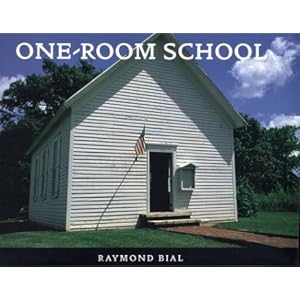
For my book, I chose One Room School, by Raymond Bial. I loved all of the photos in this one--especially the vintage ones of a class of students standing in front of the schoolhouse.

These children were often dressed in a rugged, pioneer way, holes in the knees of their britches, etc. Some were only sod houses, one was just a bunch of tree branches bunched together in the form of a makeshift canopy.

Children sat on puncheon benches where there was an abundance of wood, back when Professor McGuffey would have been formulating his readers.

We like to think that we are so advanced these days--but we have lost the will to persevere and overcome. Lincoln, the man who wrote one of the most famous speeches in our history on the back of an envelope, started in a log hut--and we haven't seen the likes of him in quite a while.

Consider this from McGuffey's Fourth Reader (original) with the notation Beecher:


We must educate! We must educate or we must perish by our own prosperity. If we do not, short will be our race from the cradle to the grave. If in our haste to be rich and mighty, we outrun our literary and religious institutions, they will never overtake us, or only come up after the battle of liberty is fought and lost, as spoil to grace the victory, and as resources of inexorable despotism for the perpetuity of our bondage. 


But what will become of the West, if her prosperity rushes up to such a majesty of power, while those great institutions linger which are necessary to form the mind, and the conscience, and the heart of that vast world? It must not be permitted.

Awfully prophetic, wasn't it?

Saturday, April 7, 2012

Good morals and gentle manners

From McGuffey's 2nd reader (revised)
Once upon a time, in the land under our feet, the Bible was the unquestioned sovereign of all books. In this land, parents, teachers and all other officials, including the president, public representatives, and Supreme Court justices agreed that children should all be taught from this book.

It was during this time that a textbook company chose to publish a text that explained morality and manners from a Biblical perspective. Its title was "Good Morals and Gentle Manners".

I have been reading this text aloud to my children. There is no mention of "self esteem" and no promises of having a "perfect life now". In fact, the whole focus is on one's duty to God and man.

Way back when, the word "duty" was not dirty. Certain things were expected ("musts" Charlotte Mason would have called them), and no apologies were made, no excuses offered.

There is a danger in reading this book; if a child (or adult) were to read these pages, he/she would be accountable. There would not be any hiding in ignorance, and so such a person would probably experience...GUILT!

But the most marvelous, wonderful thing of all is that this guilt could lead to the realization that everyone needs their sins to be atoned for, and so the fallow ground would be ready, it would be broken up and made pliable and receptive for the seeds of the Gospel--the good news that Jesus came to forgive, He came to die and bleed for the trespasses of mankind!

As I have been so enjoying books by Ray Comfort lately, I am greatly enthusiastic about sharing this with my children. I don't want them to grow up with a "pseudo" faith, I want them to be genuinely converted.

I have often wondered that the reason we had experienced so many sweeping revivals in the past is that people of the past were well schooled in what depravity and separation from God really meant. It was only in the realization that Jesus died to save them that they experienced any relief from their own consciences, which had been trained from birth to understand sin and guilt.

But, thanks to ministries such as Dollar Homeschool and other online digital resources, we can turn back the clock a bit, and perhaps return to God's original plan for parents and families.

Sunday, November 27, 2011

Announcing Homeschool Sanity—the book!

Recapture the best of the past!
It's not easy being a homeschooling parent today. Educating one's children is a huge responsibility. There seem to be more "answers" than there are questions! Everyone has a textbook, or a method, or a philosophy. But how are we supposed to figure out just what path to take?

We want our children to have the very best and to grow up with the God of the Bible as their frame of reference; but the best way to accomplish this seems to be just out of our reach!

For more than 23 years I have been asking these same questions about education. During my own journey, I have read books and research by the most insightful and influential homeschooling leaders such as—Dr. Raymond and Dorothy Moore, Ruth Beechick, Charlotte Mason, John Taylor Gatto, and many more. They were true pioneers of the current homeschool movement and all were dedicated to the welfare of children and their families.

Although their messages were often diverse, I began to identify a common theme. In the last few years I have discovered the Eclectic Education Series, and all those threads began to reveal an incalculably rich tapestry of education resources, that for many were lost to the past.

My heart was burdened with the realization that there are many others just like me—that are seeking a way to simplify their homeschooling into a coherent system which makes room for a child's personality and gifts, but at the same time gives him structure as well as discipline.

I have come to realize that the modern educational systems and methods are strangely unique in our human history, and they have failed us abysmally. Never before have we had so much knowledge at our fingertips, and yet, the literacy rates of our nation's school systems are at an all-time low. Despite the fact that we live in the information age—the divorce, homicide and suicide rates are at all-time highs. Our children face greater challenges today than we would have ever dreamed, nevertheless, many don't have the tools to handle these new demands and pressures.

It is time we threw out the progressive educational philosophies and ideologies which have lead us here. We need to turn back the clock and promote the fear of God which is the beginning of wisdom. We must revive the unswerving Christian devotion that used to be lived out by our predecessors before the present narcissistic influence of humanism took over!

We can rediscover the tools of learning that helped our forefathers overcome the great obstacles of their time, that have only recently been replaced by "dumbed-down" work texts and worthless statistics which require no higher thinking on the part of young learners.

Homeschool Sanity: a Practical Guide to Redemptive Home Educating is my attempt to communicate a way back to common sense learning. It is a pathway back to the simplicity and joy of gaining the knowledge born out of the reverence for the God of the Bible. It is a journey filled with the grace and truth of Jesus Christ.

This book is easy to read. Even if one only has time for perusing, something useful and encouraging will be achieved (I have included a few pages in this article from my book for your consideration).

It is full of colorful and engaging graphics, helps, charts, templates and resources. Even the busiest mother will be able to breathe a sigh of relief as she reads just how easy it is to give her children an education that will be a blessing to them for the rest of their lives!

Here is a small portion of what I have included in Homeschool Sanity's 160 pages:
  • An overview of the different methodologies of homeschooling
  • A brief history of education in America
  • Preschool
  • Reading and literature
  • Grammar
  • Arithmetic 
  • History
  • Science
No fancy psycho-anything here. I have rediscovered precisely why things used to work, and why they are so very broken today. I hope to lead the way into a fresh attempt to bring back the best of the past in order to prepare our children for the best future possible.

In essence, I have tried to make learning the "old" ways as convenient as possible for our modern lifestyles.

This is why you will find many nifty charts and templates ready for your use. You will discover a catalog of successful methodologies for your own re-education. If you are like me, you will not feel tired and anxious after you read my book; you will be refreshed and filled with real hope!

Many thanks to Dollar Homeschool for the wonderful resources offered in the form of the Eclectic Education Series. This book would not have been possible were it not for the opportunity I had to write the guides for each of the wonderful Eclectic collections.

Thursday, November 3, 2011

The church in your home, Spurgeon

This quote is taken from Charles Spurgeon's devotional book "Morning by Morning", published in 1866:


If there be such a Church in our house [Philemon 2] let us order it well and let all act as in the sight of God Let us move in the common affairs of life with studied holiness diligence kindness and integrity More is expected of a Church than of an ordinary household family worship must in such a case be more devout and hearty internal love must be more warm and unbroken and external conduct must be more sanctified and Christ like We need not fear that the smallness of our number will put us out of the list of Churches for the Holy Spirit has here enrolled a family church in the inspired book of remembrance As a Church let us now draw nigh to the great Head of the one Church universal and let us beseech Him to give us grace to shine before men to the glory of His name.