Thanks for visiting my blog, you can join me by subscribing
Showing posts with label Using the McGuffeys. Show all posts

Thursday, May 23, 2013

Old-fashioned Spelling


I have read that other countries, whose languages are "phonemic" never need spelling lessons.

But good, old English is just too hard to nail down; there are almost as many exceptions as there are rules!

I have tried to teach my children to spell more ways than I can count. I have used a textbook, corrected the words in their own spelling (natural), used a group of words in a list which were related, etc.

I have also read about how Charlotte Mason taught children to spell (I believe she and Professor McGuffey would have gotten along--although his students were from a much different background than hers--doing lessons on the backs of shovels, etc., although she would have really appreciated that they all lived in the out of doors...but I digress) by having them look at a word, and then close their eyes and "visualize" it, then open their eyes and write it. In this way they are reinforcing their visual memory of each word.

Funny, but most of us do this very thing--we rely on how a word looks to us. This can become very difficult after correcting some of my children's writing--I get mixed up myself after seeing things spelled so very "interestingly" so often.

We sometimes play a little game with our McGuffey spellers--the ones I printed from Google books a while back and had spiral-bound. I hand out small slips of paper and split my children into two teams. Then I put the two teams on either side of my huge dining room table, each across from a child at his/her approximate spelling level. I then assign each group of two's an appropriate spelling list to draw from in the Speller, such as lesson 27 for one, 77 for another, and so on. Then one person selects ten words from that list to proctor to the other person across the table, and so on down the line (we have enough readers for three on each side). At the end all of the lists are corrected and the team with the most correct wins!

This only takes a few minutes to do, and I don't have to be directly involved, yet it gives them all extra practice and a little fun besides.

I don't know if it actually has helped them spell any better, however! It just makes me feel better (I love these old books and relish any way I can use them).

Sunday, April 21, 2013

Irregular Learning


A walk around the pond
I am really enjoying what we are doing for school. The children are learning so much, and I can see their progress.

The ones who are just beginning are already showing areas that are their strengths, and others that are their current weaknesses, but I am not concerned. I have learned that, just because I child is struggling in the area of reading or math at the age of six, doesn't mean that he/she will be struggling forever! I am a firm believer that many "learning disabilities" disappear as children mature.

Of course, some of us simply are weak in certain areas, and this can take some acceptance. The idea is to strike a balance between what we should expect and challenge our children to do, and what they are actually capable of doing.


The middle girls are both growing greatly. They are doing well in their McGuffey's, and they are moving steadily forward with their Ray's Arithmetics, both in different places in the Elementary book. The story problems can sometimes be a little difficult, but that is when we get out the chalkboard and make pictures.


Questions about math
Besides their regular work, these girls read voraciously, and one has decided to do a number of lessons in Long's Language each week, and she loves memorizing the little poetry as she is directed, etc. The other has been working through a writing curriculum from 7 Sisters which I won as a prize through the Homeschooling Blog Awards. She already gobbled her way through the poetry section, totally on her own, and now is zipping through the short story portion--and loving every minute! She definitely has the writing bug.

The older children have a great time with the McGuffey's and Ray's, the daughter of the two really, really loves McGuffey--she would do four lessons a day if we had the time. She not only likes to do the lessons, but she likes to share what she is discovering through them with all of us. She is very quick, and she loves to decorate the pages as she does her work in her copybook. Ray's is her favorite, though, and she would probably do that all day--she is always asking for more time to do it! She also excels in domestic skills, is learning to create a pattern on her own and sew her own clothes, has been doing little stitchery works, and will be baby-sitting her niece once-a-week. She is hoping to learn DSLR photography and put her photos on her blog.


Long's Language work
The son of the two is so full of artistic creativity--and yet he can also be technical. I hate to hamper him in any way, but I have to help him by goading him a bit now-and-again and making him do his lessons (well). He is sweet about it, though, and sees the wisdom of it himself. He can sometimes feel as though his creativity makes his mind wander from one wonderful thought to another in rapid succession, so I am trying to help him to learn how to discipline his gifts (the spirit of the Prophet is subject to the prophet).  He is working on learning to use the Adobe creative suite, and his handiwork is fantastic! Perhaps someday he will be selling them through our website, one that he is currently working on with much fervor so that we can launch it soon. Probably then this blog will end up there...

Meanwhile, both are also  reading, the Creative is often found with his nose in something from J.R.R. Tolkien (he wrote more than just the ring trilogy and The Hobbit) and the Dear Young Lady is searching for something to follow up after reading all of the popular classics.

Together we have finished a concentrated study of the etymology of the English language, fascinating and one which has enabled the children to have a better grasp of vocabulary, grammar, even spelling, with a greater appreciation as to how our Bible came to us. Of course, we studied all of this because I found it so fascinating, and the children caught my enthusiasm!

Sarah sewing
Our current studies together include an overview of all punctuation (I repeat this study periodically, using different methods, etc. to reinforce their own studies) and have daily short dictation exercises.
I have also begun to cover all sorts of very practical areas of living in greater detail, such as our current study of microbiology and keeping our homes and our lives healthy. I am planning on covering all sorts of growing-up skills, such as caring for clothing, nutrition and cooking, etc. I am taking these subjects on because I have often assumed that they just "know" because I have learned about these different areas and become skilled in homemaking slowly over many years, and I forget that this is a new group that needs to be taught and led more specifically.

Of course, I am enjoying each subject, even each part of each subject. Whenever I get feeling pressured, my loved ones will suggest that I put our little learning sessions aside for a time. What they don't realize is that I would gladly give up a lot of other things, but our learning times are the best parts of my day! My oldest daughter, who also home-schools her children, feels very much the same! 

Thursday, March 28, 2013

How You Can Teach Your Children Reading with the Revised McGuffey Readers


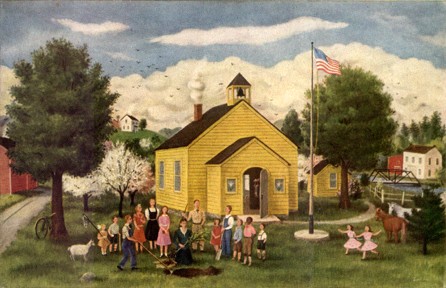
One room school-house

Someone on the CMOMB (Christian Moms of Many Blessings) message group recently asked me to give some examples of how a typical schedule or routine of someone using the revised McGuffey series could look like, so I thought I would post a few ideas here so that others might gain some insight from them as well.

Here is how we typically go about things:

Each child is assigned a McGuffey's Reader. I have chosen these, not only according to their reading abilities, but their writing, spelling and grammar abilities as well. Some of my children are actually reading a bit better than their McGuffey's level, but are not as confident when they are creating original sentences, etc.

I do not feel strange about starting a child in the middle of a reader, if that is his/her level.

Those that are at the middle of the second  reader level and above are required to read their lessons to themselves. Next, they are required to copy one paragraph from a prose lesson, and each lesson that includes poetry in its entirety (very often these will not include words lists, hence the extra work). They also must write the gist of the lesson in their own words (narration). When all of these tasks are completed, I might ask them to extend their lessons by creating a notebooking page suggested by a subject from their lesson, such as a biography of the author or a page on a bird mentioned in a poem, etc. (when they complete these assignments they are to hand their work to me and I then go over them for neatness, accuracy, interest, and correctness).


While these older children are working independently, I take time with the pre-readers. I try and keep their lessons as short and sweet as possible, and we usually sit on a couch together and snuggle a bit. This is precious time that I really enjoy.

I like to use the alphabets printed at the beginning of the Primer and the 1st reader for some general practice, just to get my youngster familiar with all of the symbols and what they are supposed to do for us. I might sing the "ABC Song" while I touch each letter, then hold her finger and help her to touch each letter while we sing together. I might continue this practice off-and-on for many days, or even weeks if the child is very immature.

A sample of my flashcards

I also love to introduce the sounds of each letter using phonics flash cards ( I have created my own set, which can be bought along with my entire guide for a minimal fee, downloaded and printed on card stock). At first I will use the whole deck and rely on the pictures to add clues as to the sound of each letter, but after a time I will cover up the pictures and concentrate on about four of these at a time until they are mastered.  Also during this time I might play "find it" with the different alphabet symbols on the first pages of the Primer.

Also, especially with those who are very new to reading, I will go over at least the first few lessons in Teach Your Child to Read in 100 Easy Lessons. This usually breaks them into the idea of "sounding out." But I have also learned over the years that total reliance on sounding out each and every word is not only cumbersome, but it is also unnatural. Most of us sound out some, anticipate (make a guess based on context) some, and memorize some of the words when we are beginning to read. I allow the use of all these three strategies when I am teaching a beginner.

This is how a typical week might look:
Day one--sing the alphabet song while pointing to the letters. Have the tiny one sing with me as I point.

Day two--repeat the same lesson--keep it short but fun.

Day three--the same, only this time ask if the tiny one would like to sing along.

Day four--this time we are both singing, and I am helping my child point to each word.

Repeat the same for a few more days.

Day ten or so--take out the phonics flash cards and lay them all on the floor in a "train" fashion. Walk along the train and sing the ABC song. Have the child pick up the cards as you sing the name.

Day 11--lay the cards out in a train, only this time call out the name of a letter and have the child pick it up and hand it to you.
Play this game for a few more days.
Day 13--Begin to use the flash cards to practice the sounds. You can use or omit the "ch," "sh" and "th" cards as you wish.
* If you are not well-acquainted with the sounds yourself, try watching this series of videos with your child from Super Simple Songs (there is one instance of a which on a broom, so be prepared to explain). 
Days 13 through 20--continue to use the flash cards each of these days. This may sound too simple, but the simple repetition of this exercise in its consistency will help the child more than drills that take an excessive amount of time and tend to burn you both out.
Of course, throughout this process have your child color with color crayons, paint, sculpt with play dough, cut with scissors, etc. so that she can build the skills necessary to eventually be able to write, which makes reading fun, too.

Here it may be good to insert a few lessons, I would try and go through at least until lesson 10, from the Teach Your Child to Read in 100 Easy Lessons book.

* A word of caution here; not all children are automatically ready to take the next step. Some, especially boys, are just not capable of processing for reading yet. Don't push if you sense a lot of resistance, or if he/she does not seem to be able to remember sounds and words from one day to the next. The best remedy for this is not "therapy," but time! You can either give the child a break for a few months, or continue with your simple lessons until he/she is more mature (be careful not to leave a bitter taste in your child's mouth through prodding and scolding, or you might be postponing reading for longer than you realize--keep things light and happy and trust God).

If your child is eager and capable, then it is time to continue with the first lesson in the Primer.

First, take time to examine the book together. Discuss how it is bound, how old it is, how nice the pictures are, etc. Show her how the lessons are set up.


The first lesson is about a rat, which is a common creature which can be fascinating, distasteful or even scary to some children. Nevertheless, it is an easy word to understand. Take time to go over each of the sound presented. If you have used the "100 Lessons" book mentioned earlier, these sounds should not be foreign at all.

For the first days, I would read the letter sounds and the words while pointing to them in front of the child. At the second or third day, I would have the child read them after me. On about the fourth day, I would expect the child to be able to pick out the different sounds or words as I called them out.

I would also have a chalkboard or whiteboard handy, on which we could practice drawing rats and the child could watch me write the letters and the words as I said them. She should also be given the opportunity to practice these things on the board for herself. This is a method that was highly recommended in the McGuffey's teachers manuals I found on the Dollar Homeschool collection for the EES.

On the fourth day, I would have the child attempt to read the lesson for him/herself, with help, of course.

To keep things fresh, I would then move on to the next lesson, and proceed much in the same fashion as for the first lesson.

As the lessons progress, I would encourage lively discussions about the illustrations. Language arts is about communicating with language, and oral expression is one of the ways we communicate with each other. Instead of asking questions such as, "Do you like this picture," I would ask questions like, "What are the children in this picture doing?" and, "What do you think will happen next?"

Having the child create a notebooking page with their own drawing of the illustration in the book and a few letters underneath may be another way to reinforce what is being learned. 

* When you come to the review lesson V, you may notice some cursive writing at the bottom of the page. This is included because children were taught to write in cursive script from the very beginning. There are those that still swear by it, but we must keep in mind that most of the students of the past did not enter formal schooling until the ages of seven or eight. The find motor control necessary to produce script might be beyond most 5-7 year-old of today. However, it may be of great benefit to your child to teach him/her how to read simple script from the beginning, and if a child wanted to practice copying such writing you could definitely help him/her. 

It is very important to keep in mind that mastery is more important than progress. In other words, if a child is having difficulty with a lesson, it is better to take the time to master that lesson than to move on. Keeping the lessons short and sweet will help you to keep the frustration level down for both of you. Don't fall into the temptation to "drill 'til you drop"--this can prove disastrous! Don't let your pride or frustration get in the way of ministering to your child's heart.

I hope this helps, and I hope that it will give someone a leg-up. I have gleaned these ideas mostly from my own experience teaching 13 of my children to read so far (two more to go!).

If you are interested in finding out more, you can purchase my book, Homeschool Sanity, and/or go to my other blog, Large Family Mothering. 

The McGuffey readers and more can be found on DVD from Dollar Homeschool.
 

Thursday, May 17, 2012

Rediscovering old authors

I really do live in the 21st century, at least most of the time.

But I also love my jaunts into the past--at least before humanism took hold of our culture. There was always vice and sin, but it was not published and flaunted as it is today. Most folks would have blushed in shame to even speak of some of the things that were done without any remorse in our Oval Office!

But the so-called "classics" that have survived and are being sold in stores are not necessarily the "cream of the crop". With my study of the McGuffey readers, and others like them, I am rediscovering some wonderful treats, which I can then find through avenues such as Internet Archive, which has collected listings of all sorts of scanned and digitized books from the past.

Here are a few of the authors which I have uncovered:

Thomas Hughes


Frank R. Stockton


Grace Greenwood, especially her Records of Five Years

And currently I am reading the novel, The Foresters, by John Wilson. This book is so explicit with Christian sentiment and thought, and it is of a family that reads the Word, sings hymns, and prays together more than once a day! And yet, it is very interesting and full of human pathos. I would highly recommend it!

Tuesday, February 21, 2012

Assignment sheet

Ever want to know just what it would look like to put your own "plan" together? It can seem too daunting, to feel as thought things are just not "right" until you have some sort of idea of what you will be doing daily, etc. This is why we really love those boxes of pretty books we can order and pay through the nose for--at least we feel "legitimate"!

If your are having one of those times when you just don't feel it can be done, relax. Even if your life is so hectic, such as after the birth of a baby, that you barely have time to comb your hair in the morning, you can let things "happen"--read aloud a good book over lunch, discuss it, and assign a general notebooking assignment, or whatever works, and then record it after-the-fact. You can even plan ahead using a huge calendar hanging on the all of your kitchen--give God room to help you plan your life, and it will be more blessed than the most comprehensive scope-and-sequence ever devised! Just keep the basics in mind, then fill your home and your life with the best of learning (without fluff and nonsense) and have fun.

I had to turn a recently-created check-off sheet into a picture, so I thought I would share it with everyone.

Keep in mind, I have changed these things many times, mostly because I am very creative--:)--but also because, if there is anything we can count on, things are gonna' change! So don't go thinking that there is only one way to skin the homeschooling cat--there are as many ways as there are people!

Here is the picture:


Sunday, November 27, 2011

Announcing Homeschool Sanity—the book!

Recapture the best of the past!
It's not easy being a homeschooling parent today. Educating one's children is a huge responsibility. There seem to be more "answers" than there are questions! Everyone has a textbook, or a method, or a philosophy. But how are we supposed to figure out just what path to take?

We want our children to have the very best and to grow up with the God of the Bible as their frame of reference; but the best way to accomplish this seems to be just out of our reach!

For more than 23 years I have been asking these same questions about education. During my own journey, I have read books and research by the most insightful and influential homeschooling leaders such as—Dr. Raymond and Dorothy Moore, Ruth Beechick, Charlotte Mason, John Taylor Gatto, and many more. They were true pioneers of the current homeschool movement and all were dedicated to the welfare of children and their families.

Although their messages were often diverse, I began to identify a common theme. In the last few years I have discovered the Eclectic Education Series, and all those threads began to reveal an incalculably rich tapestry of education resources, that for many were lost to the past.

My heart was burdened with the realization that there are many others just like me—that are seeking a way to simplify their homeschooling into a coherent system which makes room for a child's personality and gifts, but at the same time gives him structure as well as discipline.

I have come to realize that the modern educational systems and methods are strangely unique in our human history, and they have failed us abysmally. Never before have we had so much knowledge at our fingertips, and yet, the literacy rates of our nation's school systems are at an all-time low. Despite the fact that we live in the information age—the divorce, homicide and suicide rates are at all-time highs. Our children face greater challenges today than we would have ever dreamed, nevertheless, many don't have the tools to handle these new demands and pressures.

It is time we threw out the progressive educational philosophies and ideologies which have lead us here. We need to turn back the clock and promote the fear of God which is the beginning of wisdom. We must revive the unswerving Christian devotion that used to be lived out by our predecessors before the present narcissistic influence of humanism took over!

We can rediscover the tools of learning that helped our forefathers overcome the great obstacles of their time, that have only recently been replaced by "dumbed-down" work texts and worthless statistics which require no higher thinking on the part of young learners.

Homeschool Sanity: a Practical Guide to Redemptive Home Educating is my attempt to communicate a way back to common sense learning. It is a pathway back to the simplicity and joy of gaining the knowledge born out of the reverence for the God of the Bible. It is a journey filled with the grace and truth of Jesus Christ.

This book is easy to read. Even if one only has time for perusing, something useful and encouraging will be achieved (I have included a few pages in this article from my book for your consideration).

It is full of colorful and engaging graphics, helps, charts, templates and resources. Even the busiest mother will be able to breathe a sigh of relief as she reads just how easy it is to give her children an education that will be a blessing to them for the rest of their lives!

Here is a small portion of what I have included in Homeschool Sanity's 160 pages:
  • An overview of the different methodologies of homeschooling
  • A brief history of education in America
  • Preschool
  • Reading and literature
  • Grammar
  • Arithmetic 
  • History
  • Science
No fancy psycho-anything here. I have rediscovered precisely why things used to work, and why they are so very broken today. I hope to lead the way into a fresh attempt to bring back the best of the past in order to prepare our children for the best future possible.

In essence, I have tried to make learning the "old" ways as convenient as possible for our modern lifestyles.

This is why you will find many nifty charts and templates ready for your use. You will discover a catalog of successful methodologies for your own re-education. If you are like me, you will not feel tired and anxious after you read my book; you will be refreshed and filled with real hope!

Many thanks to Dollar Homeschool for the wonderful resources offered in the form of the Eclectic Education Series. This book would not have been possible were it not for the opportunity I had to write the guides for each of the wonderful Eclectic collections.

Sunday, November 20, 2011

Tutorial--Printing and Binding eBooks


There are so many wonderful, old, and mostly free books online--one just can't help but download them and pour over them from one's hard drive. But reading these and sharing these, especially with children for their education, is another story.

I have decided I want to read these, not in their electronic form, but in as close to the look and feel of a "real book" as possible. I also want to make sure that if I go to all the trouble of printing and binding, these books will last as long as possible, so that as many of my children as possible can enjoy each one.

I have done general how-to's for printing and binding options before, but here is a step-by-step breakdown of how I print and bind mine.

To begin with, I have an auto-duplexing printer, meaning it automatically prints on both sides of the paper. This has been a blessing for me! I use the HP Office 8000 Pro. Besides its auto-duplexing feature, I chose this one because the cost of ink was so low--just over 1 cent per page! (the cartridges have a 2,200 page yield, and yet cost the same as cartridges for any other HP inkjet meant for personal use).

After bringing up whatever book I want to print, whether in PDF version or in Microsoft Office, I pull down the file menu and click on the print option.

Within the print window I click properties. In the next dialog box I select "booklet printing." I then check the "OK" box. When the original print window returns to the front of the screen, I plug in the pages I want to be printed.

This is a very important step. Even if a book is 400 pages long, it is best not to print any more than 20, double-sided pages at a time. 

Printing just that many pages allows for any errors, because when you print in booklet form the pages are numbered in a very specific way so that they will be in sequence when they are bound together. Also, printing just a few pages at a time allows you to bind them together so that they look and behave more like a book when you are finished.

I keep a tally sheet close to the computer and list each set of pages, such as:

1-20
21-40
41-60
61-80, etc.

I put a check on the left hand side of the number as I begin to print, and on the right side of each number as the printing has been completed. This simply tallying system has saved me so much grief as I am often interrupted while going through this process.

After I have printed all of the "booklets" and stacked them in a staggered way so they will not become confused, I begin the process of stapling each booklet in the middle. I try and stagger the staples, which helps the spine of the book to be more even when I finally glue all of the separate booklets together.


I then proceed to fold each carefully along the stapled middle. I use some sort of instrument (in this picture I am using the barrel of a marker) to make sure the fold is crisp and precise.


 After folding I stack the separate booklets up in order. Then I use two rulers with some binding clips to hold the pages as I use a hot glue gun and a Popsicle stick to glue the pages together. After the pages are glued, I measure the spine.


I then take a manilla folder, which has fold lines already in the middle, and measure just how many folds will be necessary for the spine of my book. In this instance, I find I will have to add another crease, so I use a ruler and the blade of an open pair of scissors to score the folder so that the crease is neat and crisp.


I use my paper cutter to cut the length of my book cover to just a smidgeon over 8.5". I then proceed to measure the sides of my book, making sure I allow for the spine, to a little over 5.5" each.


I then use my hot glue gun in the gutter of the manilla folder which I have just cut, and quickly apply the booklets I have previously glued together. I use my fingers to make sure the spine of the book is well-adhered to the folder.


For added security, I apply a bead of hot glue just inside the front and back covers, where the pages meet the spine.


I like to take some of the time between printings to design front and spine covers for the finished book. I use Microsoft Publisher to do this, but one could use PrintMaster, or even the open-source program GIMP.


I like to create a sort of "sticker" to put on the front of the book by using an interesting image from the PDF of the book itself. It is easy to clip one of these, copy it using either by pressing down the control key and the letter "c" at the same time, or right clicking the image and selecting "copy." I then open up the graphic design software and paste the picture (again, using the control key and the letter "v" at the same time, or by right-clicking and selecting "paste" in the drop-down menu).

I have been able to enhance my cover designs by taking advantage of the many black-and-white vintage images at Clip Art Etc. I have especially enjoyed their decorative letter section, which make my otherwise bland covers look a bit more "Victorian" and appropriate!

The spine cover is done by using one of the banner designs from Clip Art Etc. and filling it with the title of the book and the author or publisher, where appropriate.

Of course, it is important to estimate the size of each of these "stickers" before saving and printing them!

After I have printed and cut out my labels, I place them on the book where I would like to see them glued, then draw a light pencil line around them. I then put a light coat of Elmer's rubber cement on the front of the book and the back of the label. After both of these dry, I put the label on the book (this is an old graphic designer's trick--it is a much better method than simply applying and pasting a paper object).


My last task is to cover the whole book in clear plastic laminate; if I am going to this kind of trouble to print and bind a book, I am going to make sure it lasts through more than a couple of children!


Measuring the clear paper.

Cutting off the corners helps when wrapping the plastic around the cover.

Folding the plastic under.

Adding a bead of melted glue on the ends helps with security and longevity.


Opens and feels like a "real" paperback book.

Two finished products--printed from Living Books Curriculum

Wednesday, October 26, 2011

Why use some old books?

I received this recently via email:
I'm really thrilled with our eclectic approach this year.  It's been a bit slow going but I'm muddling through lots of information.  My children really do enjoy the McGuffey readers as there is no busy work.  It's simple yet deeply thought provoking, and pure  - whatsoever things are pure, whatsoever things are lovely (Phil 4:8)....think on these things - that's been my homeschooling verse that the Lord keeps putting on my heart and no other curriculum or whole books have really fit until now.  It almost seems too simple, yet I can see that my children are thinking, really thinking.  It's refreshing!--sent by Patricia

Simple,

thought-provoking,

pure,

children that are really thinking,

refreshing;

these are the ways these books are herein described.

Whatever is based on God's Word is timeless.

Tuesday, October 25, 2011

Facebook for Eclectic Education Series

Aaron Jagt, the gentleman who produces the Eclectic Education Series on CD, has begun an new Facebook group--this should be a place where folks can have their questions answers concerning using the McGuffey Readers, Ray's Arithmetics, etc.

Here is the link:

Eclectic Education Series Official Group

Tuesday, June 7, 2011

Home book-binding and Dollar Homeschool review


A day at a frontier school.
I am always looking for better ways to help my readers discover the simple, wonderful world of 19th century learning. I have recommended all sorts of resources, from the high-end, hard-bound sets of reprints in these blessed materials, to downloading free eBooks from Internet Archive and Google Books.


I love all types—I have three sets of hard-bound McGuffey's Readers, Harvey’s Grammars, Ray’s Arithmetics, etc., besides having downloaded, printed and comb-bound a number of these books and other resources which my children are using (Once I did 12 books at one time—my dining room looked like a publishing house!—HP loves me).


Recently I received a number of CD’s containing what was entitled "The Eclectic Learning Series" published from the 1830's to the early 20th century in the mail from Dollar Homeschool. I was curious as to how user-friendly and useful these collected works would be for myself and others, so Aaron Jagt sent me a copy of the set so that I could review them.


Aaron has done a great job of putting a pretty comprehensive compilation of these old tomes together. I was pleasantly surprised to find much more was included than is listed on his website. Each disk was like opening a present at Christmas!


For instance, I wasn’t expecting to find sound recordings of lectures on the godly nature of mathematics. I can imagine hours sitting and listening to these while the children are sketching or doodling on a hot summer’s afternoon.


Also included is a series of books which attempt to teach grammar and composition through literature, using both copy work and dictation. I had just been researching such an approach among the free books online, so it was such a relief to find that one had already been included!


There is enough material in the history section for copy work, narration, timelines, etc. to last many years—including poetry.


I have become an enthusiast of 19th century learning materials because they were formulated and used during a time our society was greatly influenced by Biblical Christianity. Professor McGuffey himself was a Presbyterian minister. Also, to a great extent, these materials were created before many of the most radical “reforms” of Horace Mann and John Dewey were accepted "at-large" and implemented (although their eroding influence is evident even in the revised McGuffey readers of the 1880’s).


I get excited when we use these materials because of the clarity of thought, and the respect paid to the learner. No dumbed-down content here—economy was a necessity of the past, when paper and ink were precious, especially in the frontier schools. Each word, each number problem, was well-thought out and meaningful. The curricula of the age were free of “busy work”, making them just perfect for application in homeschools and tutoring programs where consistent, concentrated instruction is the preferred method.


I know many of these books are available for free online, but I also know the sites on which they are offered are not always reliable, and I have recently found it difficult to find many of the titles necessary for a well-rounded Eclectic Series education (discovering the entire set of revised McGuffey’s editions can be like chasing a snake through the grass). It can also be confusing with all of the different versions of each of the Ray’s Arithmetics, for instance. I could see spending a bit of money in order to own this compilation for the duration of my children’s homeschooling educational years.


I did some figuring to help show the actual costs of these materials. I found there were 109 books total included in this package (if I have not missed any). This does not include the audio CD. If the asking price is $160, this makes the books cost approximately $1.47 each!


Of course, these are “digital” books—not easy to take to one’s room and study, unless you happen to have a number of computers for each child or a few of those nifty “reader” devices or an iPad. These devices would make the use of these excellent "digital" books much more “portable”.


For myself, I prefer to have the “tangible” form of books. I like turning pages and making places for more books on my library shelves. This is why I am planning on printing and binding a number of these books.


I figure that, on my little ink-jet, I should get about (700-800) pages per cartridge, that is using the “economical, black-only” setting. If I select "two-to-a-page" printing, this means I should be able to print about 15, 90-page books or seven to eight, 150-page books per cartridge (at $26 per cartridge). This makes it approximately $1.73 - 3.46 per book (or twice that for a three-hundred page book).


The paper is not very expensive, since I purchase it in ten-ream boxes from either Sam’s Club (free shipping) or a local office supply store where it was on sale (I noticed a ten-ream box on sale at Office Depot for about $25). This keeps my paper for a 90-page book (with the “two-pages-to-a-sheet” mode selected) at about $0.27!


Dollar Homeschool’s agreement states a person can print up to four copies of each book for personal use, which is plenty.


So here’s the breakdown in current prices for binding a 150-page book, using the “economy” and “Two-pages-per-sheet” settings:


$1.47—average cost of digital book
$3.46—ink
$0.54—paper
$2.00—comb-binding
$0.50—miscellaneous expenses
$7.97 per book! (or $0.03 - 0.05 per page)


This is such a frugal way to go, even if one has to put in a little “sweat-equity” in binding the books, especially when compared to other curriculum options. Even finding these materials is challenging.


These books are non-consumable, so they can be passed down from child-to-child, making this a one-time purchase for many years’ worth of learning.


I went on line and compared the costs of a popular mathematics curriculum to what’s included here—an entire elementary course in mathematics would cost upwards of $600—and then there would be the expense of replenishing some of the consumable workbooks required for the course.


Printing the books included on the Ray’s Arithmetics Dollar Homeschool CD, that is all 39 of them, would equal about $348 (and you probably wouldn’t want nor need to print out all 39).

Printing and binding all of the basic McGuffey readers, at the $0.03 - 0.05 per page rate, would cost approximately $51.94 - $84.30.


For our little homeschool group, I am considering purchasing my own manual comb-binding apparatus. I am looking seriously at the Fellowes Star for about $55 on this site. It would make sense for us, since I love binding up books and booklets and should make it worth the initial investment in little or no time!


My oldest daughter is looking into the “click and print” option which is being offered by a number of printing houses. I will try and post her findings at a later date.


I am also considering printing up “booklets” of assigned material printed from the digitized books and catered to each child, which might include some note booking pages. In my thought processes are some extra practice booklets compiled from the White's and Dubb's math books. It would also be fun to create note booking pages for the Nature Study book.


It must be obvious that these materials would have to be supplemented with more up-to-date publications as well. A good set of encyclopedias and the Internet are a good start, and a library card would be a frugal way to round-out and complete a good education with these "digital" books as the foundation. Still, for the cost of just one year’s curriculum for one child, it is nice to own materials enough for many years (for example, Rod and Staff complete 1st grade, reading and math, costs $132)!


In case you feel as lost as I did when I began my homeschooling journey, Dollar Homeschool offers a Yahoo discussion forum with a number of archived discussions which helped me enormously when I began this review.


I do wish that the Manual of Methods was included on the McGuffey’s CD, as it really helps to clarify the use of these books in teaching reading—even takes one through the different methods in a more succinct way than I have ever read it expressed. I’m going to suggest this to Aaron Jagt so this may be changed in the near future.


If you are like me, prone to “creative meanderings”, then these materials are for you. Using these books allows me to enjoy my creative side, while giving me a basic structure that is sound and Biblically-based, free of a lot of the nonsense found in so many of the expensive alternatives of our present day.

My Ray's Arithmetics and McGuffey's Primer Helps go perfectly with this set for teaching basic math and beginning phonics and reading!