Thanks for visiting my blog, you can join me by subscribing
Showing posts with label Good old books. Show all posts

Monday, May 27, 2013

Teen Guide to Homemaking


A number of years ago I picked up a stack of books at a thrift store for about $.25 a piece. Among them, and much to my amazement, was a textbook which was entitled, Teen Guide to Homemaking, a book originally published in 1961 (more than 52 years ago) and written for home economics classes in schools. Without giving it any further thought, I placed it on the bookshelf along with numerous other titles.

Before long, it began popping up all over the house; I found it under beds, on the coffee table, under the pillows on the couch. Even today, this is one of the most popular books in our home library.

The titles of the chapters and the information covered are simply fascinating to my children; making friends, choosing clothing and hair styles, personal grooming and general health (such as bathing and nutrition), cooking, decorating, sewing, entertaining and family relationships. Basically, it is about growing up, and, just like most children who are not being brain-washed into thinking that life exists in a cubicle, they are engrossed with the subject!

Of course, this book was not written from a Christian perspective, and I am now very conscious of the "social engineering" that was going on between the lines. Still, there was enough Christian influence still in existence so that there was even a photo included of a young lady holding a Bible.

As a homeschooling mother, I have so often felt apologetic about taking as much time to teach our children about practical living as we do about the essential school subjects. Transcripts don't have slots to record all of the best learning that really goes on in a young person's life.

But there is so much more required of us than just gaining a degree or forming a career path. The total of our lives is much richer than what we do; it is who we are and what we offer to others that counts the most. 

Homemaking is the best place to put all that we learn into beneficial practice. By thinking of our homes as a microcosm or miniature community in the scheme of a much larger design, we can use every discipline to create a wholesome atmosphere in which human beings can thrive, and, more importantly, where seeds can be planted and nurtured until there is fruit for God's Kingdom and glory!

That wonderful little book gave me quite a lot to think about indeed.
 

Saturday, May 18, 2013

Creating answer key booklets for the Ray's Arithmetic series


I am very thankful for this "electronic age," which I believe God is using as a great blessing around the world. But I still tend to be very much the "analogue" in many ways!

It is still hard for me to do any serious reading and studying from a screen, so I prefer 3-D books that I can hold. This is why I spend the time to print out and bind books from the past. 

As our children have been using the Ray's Arithmetic Series for their math, we have found it quite inconvenient to have the text printed, but the answers still in their digital form.
This is why I chose to print the answers out separately, create covers, and then staple them into booklets. The Dollar Homeschool discs have made this all so simple because the answers are separated into separate files. 


Here is how I create the covers for these booklets:

I first select the title page of the book and copy it. Then I paste it onto a Microsoft Publisher (there are similar programs that are open-source and therefore free, such as scribus) page, with a landscape orientation, making sure that the cover material will fit neatly on the right half of the page. I like to put a text box with the words "Key to" somewhere above the title page. 

I also like to use a border from Clipart Etc. (you can find these under the "design" section). Here are some links to ones I have used:


I arrange the two pages so that the title page fits neatly inside the border, then I print my composition out onto card stock. 

I print the answers out two-pages-per-sheet, and two-sided, then I stack these pages on top of the cover I created and staple them all in the middle with my long-arm stapler (this tool was worth every penny I paid!).

I keep the booklets in my special "teacher's drawer" for easy access for both the children and myself. 

Monday, January 7, 2013

The Inspiration of Duty


I slept and dreamed that life was Beauty;

I woke and found that life was Duty! 
Author unknown

Our age is the age of SELF. We unflinchingly proclaim it in bold letters on billboards and on magazine covers and declare it vociferously from podiums and pulpits too. It's the same dribble that we find saturating every talk-show on each and every television station.

The word "duty" has been demoted to a chest of relics of times past; one in which sentries died at their posts. These days we always stop and ask, "What will this do for me?" before we proceed with anything. In fact, self-seeking has become so rampant these days that anyone who offers help without expectation of pay or any other benefit is either thought to be mentally ill or mentally challenged. 

Irena Sendler 1943
Irena Sendler clearly was not an opportunistic woman. She continually risked her life during the horrible years of the Nazi occupation of Poland to save 2,500 babies and children, and when found out was tortured, her legs and feet were cruelly broken by her interrogators. Yet, she did not seek recognition. As a matter of fact, this heroine went widely unnoticed until the year 2000. For many years after the War she was persecuted in her own country by the communists for cooperating with the Polish government during its period of exile.

When she was interviewed as an elderly woman, she did not wonder why no one had acknowledged her, honored her, or offered her any material reward for her sacrifices. Her greatest concern was that she could have done more; can you imagine that?

In our home we have never offered monetary reward to our children for doing their chores, no, not even for "special projects." We all pitch in, and we all contribute, because taking care of each other is our duty! 

Duty is so much higher than glory, and so much more inspiring, that victories hang upon it.
William M. Thayer

Story-time!
We train school children to expect to be recognized for the slightest effort. Janet receives a certificate of achievement for saying her "ABC's," for memorizing her multiplication facts, or for cleaning the whiteboard. Does anyone stop long enough to explain to Janet that each task, well-done, contains a joy all its own? Would anyone dare suggest that she clean the class whiteboards simply because it is the right thing to do?

What are we expecting when we appear before God--a standing ovation? When asked about meeting his reward in heaven, an old Jewish rabbi once remarked, "God will say to me, 'Were you good to your wife,' and I will reply, 'yes.' Then He will say, 'Were you a good father,' and I will say, 'Yes.' Next He will ask me, 'Were you good to your fellow-man,' to which I will reply, 'You, Lord God, know everything, and you know that I was!' to which He will reply, 'Good, then you did what you were supposed to do!' and that will be that!"

Sherry Hayes
Raising good daughters today means that we must learn to back away from the "diva" and "prima dona" mentalities. Nothing is owed us, everything is expected. It should never be a matter of what we can get, but what we can give, always keeping in mind that we would never be able to do anything good apart from the grace of our Lord Jesus!

Looking unto Jesus the author and finisher of our faith; who for the joy that was set before him endured the cross, despising the shame, and is set down at the right hand of the throne of God.
(Hebrews 12:2)

Monday, November 5, 2012

A precious little book

Have you been looking for a sweet book to read aloud to your tiny children, one that will capture their attention and imagination, and yet teach them some great values?

I have just found a treasure just like that, one that spoke to my heart as well as to the hearts of my tiny girls. It is The Racketty, Packetty House by Francis Hodgson Burnett (the author of The Secret Garden and The Little Princess).

This is a book about dollhouse dolls, which is right down the alley of most little girls (although there are many elements that would entertain and bring a smile to a young boy's face). The dolls of a dilapidated dollhouse are upstaged when their owner, a little girl, receives a grand, brand-new castle with new dolls, furniture, etc. and the nurse threatens to put the racketty-packetty house out to be burned.

But the residents of the old house are so sweet, so full of good cheer and kindness, that they continue to encourage each other with high hopes, and then some fairies come to help them!


Along the way my children were taught to be kind, even to those who mistreat you (just as Jesus taught), and that it is the good in heart that receive the best rewards (as those who love and serve God here by being His hands and feet to others will be rewarded by His blessed presence in Heaven).

If you can get ahold of a copy of this book, do! You and your children will be warmed and enthused, and you might even find yourself giggling at the antics of the sweet characters as Burnett has created them.

You can find this book on Google books, Gutenberg, on Amazon, or, hopefully at your local library (the first picture is the front of the 100th anniversary edition, done in 2006, and the rest of the illustrations are from the 1914 version).


Monday, August 27, 2012

Things we're about

A basket of hard-bound school books
I don't know what's happened, but I actually have a few minutes to plan each week. It must be this season of my life or something! I know that it has to do with finally landing on a system that works for us. The last few weekends I've spent a few hours sitting at the table on the deck with my planning pages on one side and a stack of readers and other books on the other. What bliss!

This last week was good, with a few hitches. We spent most of Thursday at the dentist. How many dentists do you know that will risk blocking out a whole morning for eight children? Mine is a dear, sweet peach! Only four cavities out of the bunch--that's a lot to praise God about!

Old books I have printed and bound myself
Other than that, the week was full of learning. The McGuffey readers gave us all food for thought.

As for math (we use Ray's Arithmetics), I found out that one child is about to go into cancelling but is really, really rusty on multiplication--or maybe it was just a fuzzy day. Oh well, we are again reviewing until the basics are mastered...

Another child that has always had trouble mastering math has decided to learn it by teaching it--I can't think of a better way!

A library book sorter--I think it was originally a
business file-sorter, but it's perfect to keep library
 books both accessible and neat at the same time. 
I've so enjoyed taking my little girls through D'Aulaire's history books. We've read about George Washington, Leif the Lucky, Abraham Lincoln, Christopher Columbus, and Benjamin Franklin. These books are old favorites in homeschooling circles, and with good reason. They're well written and engaging, even for the smallest children, with pictures that are colorful and just busy enough for inquisitive little minds. Best of all, God and faith are not excused from the narrative, but are an integral part. I tried lapbooking afterwards, but the ones we did were a bit too schoolish, so we abandoned them for some good old-fashioned notebooking, so the girls could enjoy creating for themselves. I also had the girls take turns narrating as I went along. The younger ones are still getting the hang of it, but Olivia, now ten, does very well and is a good example to the others. At first I was having her do her notebooking lessons alone with the older children, but she was so lonely. I finally realized that she needed to be with us, and with me, so I included her in our daily readings. She has blossomed and smiles more now. She is so sweet, and I'm so glad that I've included her. Of course, Patience, three, doesn't always sit still the whole time. I allow her to wander off and play close by. She comes back periodically just to look at the pictures, and then she loves to color when we go to the table.

This is Patience' "school box"
I have created some very special "boxes" for the two tiny girls to keep their colors, some scraps of paper, a pencil, some chalk, and a small clipboard in. They're the size of a lunch box and are plastic. These have solved a whole host of problems for me. For one thing, it keeps the mess of coloring and drawing in one very manageable place. For another thing, I don't have to drop everything to try and help them hunt up their colors and paper! Besides, they feel very special, as all little girls should! I suppose there must be thousands of used lunchboxes at thrift stores and the like that would be perfect for such an application.

Ryan has been engrossed in the creation of an "art nouveau"-style dollhouse for their woodzeez. I really must share some pictures of it when he is done. He is so creative and gifted and is painstakingly going over every detail. He has already created stained-glass windows and a grandfather clock with shelves underneath, among other things.

Sarah and I are working on creating leg-warmers to wear under dresses this winter (she is giving me a refresher on knitting). Eliana is still working on her novel about an imaginary land, complete with a map and a character list. She wants Ryan and Nicole to illustrate it for her. Sometimes Ellie works with Ryan on his dollhouse project as well. Joshua nurses our poor water-thirsty yard, always trimming and coaxing green things out of the ground despite the drought. Many of the girls have pen pals, and they love to spend time creating letters and pictures they want to send. With postage being the way it is, we tried tonight to scan a hand-written letter in and send it as an image. Way cheaper than snail-mail, but more personal than email.

As for notebooking, there have been pages and booklets about carnivorous plants, medieval dress, coral reefs, Jane Austen's Sense and Sensibility, Art Nouveau, Christopher Columbus, Benjamin Franklin and Colin Powell.

The reading lists have included Howard Pyle's The Story of King Arthur, The Phantom Tollbooth by Norton Jester, Freckles, by Gene Stratton Porter,The Witch of Blackbird Pond by Speare, and The Black Arrow by Robert Louis Stevenson.

I hope to get started back into reading novels aloud to the children, I was taking time in the morning just as they woke up this past summer, I just need to find a good time for everyone.

(for more about our curriculum and schedule, see this post on my other blog, Large Family Mothering)

That's it for here, what's up at your house?


Thursday, May 17, 2012

Rediscovering old authors

I really do live in the 21st century, at least most of the time.

But I also love my jaunts into the past--at least before humanism took hold of our culture. There was always vice and sin, but it was not published and flaunted as it is today. Most folks would have blushed in shame to even speak of some of the things that were done without any remorse in our Oval Office!

But the so-called "classics" that have survived and are being sold in stores are not necessarily the "cream of the crop". With my study of the McGuffey readers, and others like them, I am rediscovering some wonderful treats, which I can then find through avenues such as Internet Archive, which has collected listings of all sorts of scanned and digitized books from the past.

Here are a few of the authors which I have uncovered:

Thomas Hughes


Frank R. Stockton


Grace Greenwood, especially her Records of Five Years

And currently I am reading the novel, The Foresters, by John Wilson. This book is so explicit with Christian sentiment and thought, and it is of a family that reads the Word, sings hymns, and prays together more than once a day! And yet, it is very interesting and full of human pathos. I would highly recommend it!

Saturday, April 7, 2012

Good morals and gentle manners

From McGuffey's 2nd reader (revised)
Once upon a time, in the land under our feet, the Bible was the unquestioned sovereign of all books. In this land, parents, teachers and all other officials, including the president, public representatives, and Supreme Court justices agreed that children should all be taught from this book.

It was during this time that a textbook company chose to publish a text that explained morality and manners from a Biblical perspective. Its title was "Good Morals and Gentle Manners".

I have been reading this text aloud to my children. There is no mention of "self esteem" and no promises of having a "perfect life now". In fact, the whole focus is on one's duty to God and man.

Way back when, the word "duty" was not dirty. Certain things were expected ("musts" Charlotte Mason would have called them), and no apologies were made, no excuses offered.

There is a danger in reading this book; if a child (or adult) were to read these pages, he/she would be accountable. There would not be any hiding in ignorance, and so such a person would probably experience...GUILT!

But the most marvelous, wonderful thing of all is that this guilt could lead to the realization that everyone needs their sins to be atoned for, and so the fallow ground would be ready, it would be broken up and made pliable and receptive for the seeds of the Gospel--the good news that Jesus came to forgive, He came to die and bleed for the trespasses of mankind!

As I have been so enjoying books by Ray Comfort lately, I am greatly enthusiastic about sharing this with my children. I don't want them to grow up with a "pseudo" faith, I want them to be genuinely converted.

I have often wondered that the reason we had experienced so many sweeping revivals in the past is that people of the past were well schooled in what depravity and separation from God really meant. It was only in the realization that Jesus died to save them that they experienced any relief from their own consciences, which had been trained from birth to understand sin and guilt.

But, thanks to ministries such as Dollar Homeschool and other online digital resources, we can turn back the clock a bit, and perhaps return to God's original plan for parents and families.

Sunday, February 26, 2012

Creating a course of study--"Art and Anatomy"

Patience pondering
Folks are always asking me--"If I am only concentrating on the basics, then how will I ever cover all of the other subjects, such as history and science?"

There are a number of ways to cover such things, none of which need curriculum (especially in the younger years), or even a "scope and sequence", and most of which can be done by a child independently through the reading of good books.

Just think about any topic of study; while modern textbooks can give a person a good overview, they can also kill a person's natural inquisitiveness, since only the facts the writers and publishers deem necessary are published, and are presented in an often dry, matter-of-fact way that makes anything seem dull.

Learning with real books is a totally different approach. Charlotte Mason was very much in favor of such a method, and this is the most natural way to explore the universe of knowledge and understanding. Modern homeschoolers such as Dr. Robinson (of the Robinson Curriculum), and Marilyn Howshall are also in great favor of such an approach.

Just reading aloud a good book over lunchtime, such as a historical biography, or even a nature book such as The Handbook of Nature Study, and discussing it, with a dictionary and encyclopedia (or the Internet) at hand is one of the most natural ways of covering many of the things that will spark the interest and light the fires of a child's imagination.

While waiting for the repairman the other day, I made good use of the time and read to my tiny girls from The Story Book of Knowledge, to be found in the Dollar Homeschool discs. We were covering the grandfather's explanation about clouds and snow. In discussing what we had read, I went over the point about snow being a natural insulator against the cold, which caused us to think of Igloos. We immediately went over to the computer and looked for videos on Igloo building, and found quite a few. We were all fascinated by the traditional way these snow huts were created, and it was such a profitable time for us all!

My eldest daughter (at home) is naturally inclined to take a subject and study until she has almost exhausted it. She has a drawer in her room that is full of notebooks, sketchbooks, and other collections of her notes, outlines, drawings, etc. in her various areas of interest. It hasn't been necessary for me to assign or keep track of what she was learning, other than to look over her findings and listen to her when she described her discoveries. She has known intuitively how to gather the best books, and we all know where to look if one of our favorite tomes is missing!

But there are times and circumstances that create for us the need to have a plan in place. One such instance may be when one is under the oversight of government officials who require something written in the form of a "plan", or when we have a child that, despite all the best intentions, is just a little bit too addled and needs to learn to be more studious.

This is why I have developed the idea of creating a "course of study". It is akin to a unit study, but does not rely on extensive pre-work by the parent/teacher. It uses notebooking techniques, but is not dependent on loads of research from all sorts of sources that would be beyond most early readers. It uses real books, but gives just a bit more structure and delves a bit deeper into a subject.

A course of study is basically using the contents page of a real book on any worthy subject adding in other books related to the subject, and then assigning notebooking projects after intervals of reading. All of this is listed on a sheet, with space for assigned times for completion (we don't assign grades for completed work around here--if someone's work is sub-par, they do the whole thing over, besides, why would someone do something that was not their best, anyway--isn't learning have enough merit of its own without attaching any carrot on the end of the stick?). 

It is very important to pick subjects that are interesting to each prospective child. I am not convinced that my artistically gifted son needs to do research on truck engines, nor do I believe my other history-buff son needs to study oil painting techniques. I am not going to try and cover every subject ever conceived during their time with me. Instead, I am going to train them in ways to study the subjects that will be of real worth to them throughout their lives, so that they will be able to teach themselves what they need to know as the need arises. We already spend a great amount of time touching on general and pertinent knowledge during our family discussions, which can last for hours at a time!

For an instance, my very gifted and talented son would do well to further study human anatomy for his artwork. I thought it would also be a good idea for him to have a greater understanding of how his body works, and how to better take care of himself.

I have chosen to use the book, Guide to Health from the Dollar Homeschool science collection for the main framework of his study. I am also including the book, Cyclopedia Anatomicae, which gives instruction in the art of sketching human and animal forms,  and the Dorling Kindersley book, The Visual Dictionary of Human Anatomy (please note; I did not go out and purchase these books just for this study. We have owned most of these books for a long time--and bought them from various sources, including from thrift stores and garage sales. What we often term as "coffee table books" are wonderful resources for these types of studies). 

For each chapter in the main book, I have made assignments; some in the form of keeping sketches, and also writing assignments and copy work. I have put my plan in a form that is color-coded, so that he knows what is expected with each chapter. Here is what it looks like:


This is only the first page, of course

I have left myself room to embellish the assignments, since I plan on using the writing assignments to teach things such as outlining, essay writing, etc. We are using notebooking pages in various forms as the need arises. Of course, if we find any other resources that are interesting to us, we also add those as we go along.  He is keeping his finished work in a three-ring binder.

This system could also be implemented by filling in only the main chapter headings, and filling in the other reading/studying materials as the child progresses. This is great for keeping track of high school credits for a transcript, etc.

I have also created courses of study in other areas, with more well-defined notebooking pages for the younger ones, which I plan on sharing in the future, perhaps with a PDF download of our study based on the McGuffey book, "Familiar Animals".

Wednesday, February 22, 2012

Pictures of new books, notebooking pages, and fun ABC craft {Brag Thursday}

Here are some things I would like to brag about:


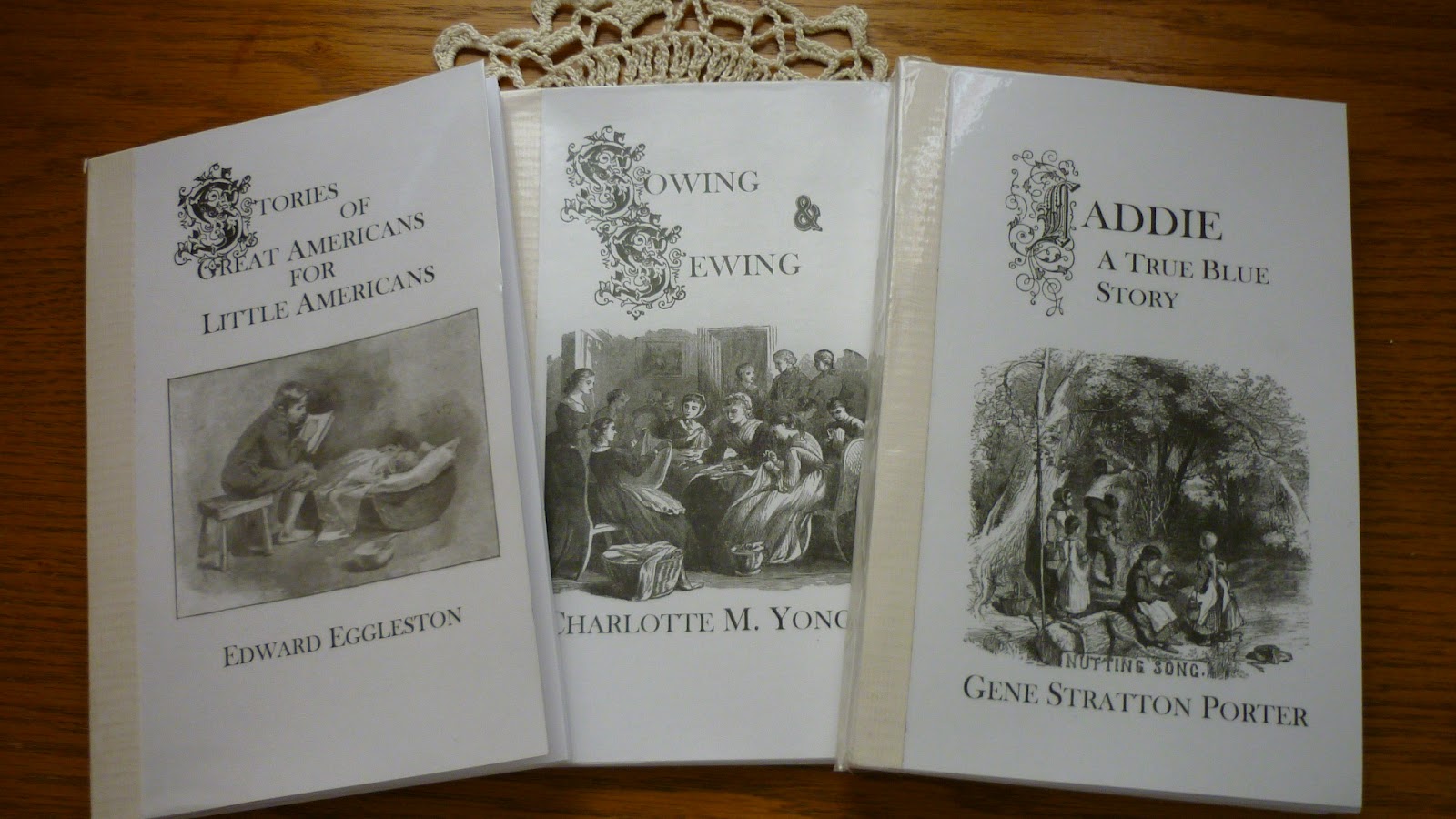
Here are some novels I printed and bound from the Internet. The first is from Google Books, the other two are from Gutenburg, after I reformatted them to fit better for space, etc. I tried a little different technique with the covers, printing them out on card stock, then using duct tape as a stabilizer after I used the hot glue gun on the spines to hold the groups of pages together--see my tutorial for more information.

Two McGuffey readers I printed and bound from the Dollar Homeschool reading collection--I am trying some colored file folders this time--so much fun to create these books that will last! I also cut the folders a little bit bigger so I could round the corners (I have a notebooking tool for this).


The other day Faith had the idea of cutting out all of the letters of the alphabet and placing them along the table--I was all for it! She got all the way to "w" before lunchtime!

This is Lorilee's work--she is a few years behind Faith, but just as eager--I loved watching her letters unfold. 

Here is a notebooking page I assigned to my dear Olivia. She is doing a study on animals based on the McGuffey book, "Familiar Animals" found in the Dollar Homeschool McGuffey Readers collection. I am so impressed with her creativity and thoroughness (She has since filled in all of the captions below the pictures she drew). 

Have anything you're proud of? Want to share something that will lend sanity to someone else? Put a link below:

Homeschool Sanity Brag Thuesday


Monday, January 16, 2012

Help!

It's mid-winter where most of us live. The skies are bleak, the ground is frozen. Our thoughts can become as bare as the trees.

Then there are the children--the lovely, lively ones who delight us.

But we worry.

"Will I get all of this educating done? Are we doing enough? How can I keep this dirty house together without neglecting their education? How can I love on my babies without letting the older children suffer? Where can I find the strength to face all of this responsibility?"

Don't look around you, look up! He is a help in time of trouble--cry out to Him! 

This will be your answer:

"I will help him, saith the Lord," (Isaiah 41:14)

"It is but a small thing for Me, thy God, to help thee. consider what I have done already. What! not help thee? Why, I bought thee with my blood. What! not help thee? I have died for thee; and if I have done the greater, will I not do the less? Help thee! It is the least thing I will ever do for thee; I have done more, and will do more. Before the world began I chose thee. I made a covenant for thee. I laid aside My glory and became a man for thee; I gave My life for thee; and if I did all this, I will surely help thee now. In helping thee, I am giving thee what I have bought for thee already. If thou hadst need of a thousand times as much help, I would give it thee; thou requirest little compared with what I am ready to give.  'Tis much for thee to need, but it is nothing for me to bestow. 'Help thee?' Fear not! If there were an ant at the door of thy granary asking for help, it would not ruin thee to give him a handful of thy wheat; and thou art nothing but a tiny insect at the door of My all-sufficiency. 'I will help thee.'" (Charles Spurgeon, Morning by Morning, January 16)

Not everything in our lives is meant to be "perfect", just made perfect by His will and intentions for us.

Yes, everyone has a challenging child, or a challenging day, or challenging circumstances. It is all about learning to rest and abide in Christ.

"Lo, I am with you always, even until the end of the age..."

Sunday, November 27, 2011

Announcing Homeschool Sanity—the book!

Recapture the best of the past!
It's not easy being a homeschooling parent today. Educating one's children is a huge responsibility. There seem to be more "answers" than there are questions! Everyone has a textbook, or a method, or a philosophy. But how are we supposed to figure out just what path to take?

We want our children to have the very best and to grow up with the God of the Bible as their frame of reference; but the best way to accomplish this seems to be just out of our reach!

For more than 23 years I have been asking these same questions about education. During my own journey, I have read books and research by the most insightful and influential homeschooling leaders such as—Dr. Raymond and Dorothy Moore, Ruth Beechick, Charlotte Mason, John Taylor Gatto, and many more. They were true pioneers of the current homeschool movement and all were dedicated to the welfare of children and their families.

Although their messages were often diverse, I began to identify a common theme. In the last few years I have discovered the Eclectic Education Series, and all those threads began to reveal an incalculably rich tapestry of education resources, that for many were lost to the past.

My heart was burdened with the realization that there are many others just like me—that are seeking a way to simplify their homeschooling into a coherent system which makes room for a child's personality and gifts, but at the same time gives him structure as well as discipline.

I have come to realize that the modern educational systems and methods are strangely unique in our human history, and they have failed us abysmally. Never before have we had so much knowledge at our fingertips, and yet, the literacy rates of our nation's school systems are at an all-time low. Despite the fact that we live in the information age—the divorce, homicide and suicide rates are at all-time highs. Our children face greater challenges today than we would have ever dreamed, nevertheless, many don't have the tools to handle these new demands and pressures.

It is time we threw out the progressive educational philosophies and ideologies which have lead us here. We need to turn back the clock and promote the fear of God which is the beginning of wisdom. We must revive the unswerving Christian devotion that used to be lived out by our predecessors before the present narcissistic influence of humanism took over!

We can rediscover the tools of learning that helped our forefathers overcome the great obstacles of their time, that have only recently been replaced by "dumbed-down" work texts and worthless statistics which require no higher thinking on the part of young learners.

Homeschool Sanity: a Practical Guide to Redemptive Home Educating is my attempt to communicate a way back to common sense learning. It is a pathway back to the simplicity and joy of gaining the knowledge born out of the reverence for the God of the Bible. It is a journey filled with the grace and truth of Jesus Christ.

This book is easy to read. Even if one only has time for perusing, something useful and encouraging will be achieved (I have included a few pages in this article from my book for your consideration).

It is full of colorful and engaging graphics, helps, charts, templates and resources. Even the busiest mother will be able to breathe a sigh of relief as she reads just how easy it is to give her children an education that will be a blessing to them for the rest of their lives!

Here is a small portion of what I have included in Homeschool Sanity's 160 pages:
  • An overview of the different methodologies of homeschooling
  • A brief history of education in America
  • Preschool
  • Reading and literature
  • Grammar
  • Arithmetic 
  • History
  • Science
No fancy psycho-anything here. I have rediscovered precisely why things used to work, and why they are so very broken today. I hope to lead the way into a fresh attempt to bring back the best of the past in order to prepare our children for the best future possible.

In essence, I have tried to make learning the "old" ways as convenient as possible for our modern lifestyles.

This is why you will find many nifty charts and templates ready for your use. You will discover a catalog of successful methodologies for your own re-education. If you are like me, you will not feel tired and anxious after you read my book; you will be refreshed and filled with real hope!

Many thanks to Dollar Homeschool for the wonderful resources offered in the form of the Eclectic Education Series. This book would not have been possible were it not for the opportunity I had to write the guides for each of the wonderful Eclectic collections.

Sunday, November 20, 2011

Tutorial--Printing and Binding eBooks


There are so many wonderful, old, and mostly free books online--one just can't help but download them and pour over them from one's hard drive. But reading these and sharing these, especially with children for their education, is another story.

I have decided I want to read these, not in their electronic form, but in as close to the look and feel of a "real book" as possible. I also want to make sure that if I go to all the trouble of printing and binding, these books will last as long as possible, so that as many of my children as possible can enjoy each one.

I have done general how-to's for printing and binding options before, but here is a step-by-step breakdown of how I print and bind mine.

To begin with, I have an auto-duplexing printer, meaning it automatically prints on both sides of the paper. This has been a blessing for me! I use the HP Office 8000 Pro. Besides its auto-duplexing feature, I chose this one because the cost of ink was so low--just over 1 cent per page! (the cartridges have a 2,200 page yield, and yet cost the same as cartridges for any other HP inkjet meant for personal use).

After bringing up whatever book I want to print, whether in PDF version or in Microsoft Office, I pull down the file menu and click on the print option.

Within the print window I click properties. In the next dialog box I select "booklet printing." I then check the "OK" box. When the original print window returns to the front of the screen, I plug in the pages I want to be printed.

This is a very important step. Even if a book is 400 pages long, it is best not to print any more than 20, double-sided pages at a time. 

Printing just that many pages allows for any errors, because when you print in booklet form the pages are numbered in a very specific way so that they will be in sequence when they are bound together. Also, printing just a few pages at a time allows you to bind them together so that they look and behave more like a book when you are finished.

I keep a tally sheet close to the computer and list each set of pages, such as:

1-20
21-40
41-60
61-80, etc.

I put a check on the left hand side of the number as I begin to print, and on the right side of each number as the printing has been completed. This simply tallying system has saved me so much grief as I am often interrupted while going through this process.

After I have printed all of the "booklets" and stacked them in a staggered way so they will not become confused, I begin the process of stapling each booklet in the middle. I try and stagger the staples, which helps the spine of the book to be more even when I finally glue all of the separate booklets together.


I then proceed to fold each carefully along the stapled middle. I use some sort of instrument (in this picture I am using the barrel of a marker) to make sure the fold is crisp and precise.


 After folding I stack the separate booklets up in order. Then I use two rulers with some binding clips to hold the pages as I use a hot glue gun and a Popsicle stick to glue the pages together. After the pages are glued, I measure the spine.


I then take a manilla folder, which has fold lines already in the middle, and measure just how many folds will be necessary for the spine of my book. In this instance, I find I will have to add another crease, so I use a ruler and the blade of an open pair of scissors to score the folder so that the crease is neat and crisp.


I use my paper cutter to cut the length of my book cover to just a smidgeon over 8.5". I then proceed to measure the sides of my book, making sure I allow for the spine, to a little over 5.5" each.


I then use my hot glue gun in the gutter of the manilla folder which I have just cut, and quickly apply the booklets I have previously glued together. I use my fingers to make sure the spine of the book is well-adhered to the folder.


For added security, I apply a bead of hot glue just inside the front and back covers, where the pages meet the spine.


I like to take some of the time between printings to design front and spine covers for the finished book. I use Microsoft Publisher to do this, but one could use PrintMaster, or even the open-source program GIMP.


I like to create a sort of "sticker" to put on the front of the book by using an interesting image from the PDF of the book itself. It is easy to clip one of these, copy it using either by pressing down the control key and the letter "c" at the same time, or right clicking the image and selecting "copy." I then open up the graphic design software and paste the picture (again, using the control key and the letter "v" at the same time, or by right-clicking and selecting "paste" in the drop-down menu).

I have been able to enhance my cover designs by taking advantage of the many black-and-white vintage images at Clip Art Etc. I have especially enjoyed their decorative letter section, which make my otherwise bland covers look a bit more "Victorian" and appropriate!

The spine cover is done by using one of the banner designs from Clip Art Etc. and filling it with the title of the book and the author or publisher, where appropriate.

Of course, it is important to estimate the size of each of these "stickers" before saving and printing them!

After I have printed and cut out my labels, I place them on the book where I would like to see them glued, then draw a light pencil line around them. I then put a light coat of Elmer's rubber cement on the front of the book and the back of the label. After both of these dry, I put the label on the book (this is an old graphic designer's trick--it is a much better method than simply applying and pasting a paper object).


My last task is to cover the whole book in clear plastic laminate; if I am going to this kind of trouble to print and bind a book, I am going to make sure it lasts through more than a couple of children!


Measuring the clear paper.

Cutting off the corners helps when wrapping the plastic around the cover.

Folding the plastic under.

Adding a bead of melted glue on the ends helps with security and longevity.


Opens and feels like a "real" paperback book.

Two finished products--printed from Living Books Curriculum