

 Posts
Posts



I just discovered this today--a wonderful video exposing the truth about American public education.
Tuesday, October 25, 2011

Facebook for Eclectic Education Series
Aaron Jagt, the gentleman who produces the Eclectic Education Series on CD, has begun an new Facebook group--this should be a place where folks can have their questions answers concerning using the McGuffey Readers, Ray's Arithmetics, etc.
Here is the link:
Eclectic Education Series Official Group
Here is the link:
Eclectic Education Series Official Group
Tuesday, October 11, 2011
Sweet quote for today
I love the sweet little verses from the past that gave children helpful moral reminders. Here is one we read today in A Hive of Busy Bees, a little book that my children have always loved, published in 1931 and written with the same moral tone as the McGuffey readers:
Politeness is how we do and say
The kindest things
In the kindest way.
The book is in the public domain and can be read here.

Politeness is how we do and say
The kindest things
In the kindest way.
The book is in the public domain and can be read here.
Thursday, September 8, 2011
The importance of homekeeping

I was recently introduced to a gem of a little book, The Nest Among the Honeysuckles, as I was perusing through the findings of Happy Hearts Homeschooling.
This sweet book was published in 1855 by the American Sunday School Union and is full of stories for little children which illustrate Biblical living.
After printing and binding the book last night, I sat down to read a bit of it so as to be familiar with it when I begin to share it with my little children. I was so delighted and encouraged to find the following passage concerning the "stay-at-home-mom", that I just had to share!
Our robin has been a keeper-at-home ever since those four bluish-green eggs demanded her attention. She has occasionally left, for a few minutes at a time, to procure food and drink, or to take a little exercise; but she has never forgotten her quiet abode, and the duties which there require her almost constant presence. She loves the green fields, the leafy trees, and the clear blue sky, and delights to hop about with her mate over the fresh grass and the clean gravel-walks; but better than all she loves those pretty eggs, which lie so cozily in the bottom of her straw-built nest.
Before she commenced house-keeping, she was very fond of travelling, and many a mile has she wandered, over hill and valley, in company with her friends. She assisted at concerts, and was universally admired; but she had the good sense to give up these enjoyments without a murmur, when higher claims called for her undivided care. Whatever is worth doing at all is worth doing well; and the robin will doubtless be repaid for the unwearied patience with which she performs her unostentatious duties. Some people are inclined to think domestic labour dishonourable, and the cares of house-keeping a burden; but our feathered friend is wiser than they. She does with her might what she finds to do, and she does it heartily. Every act of duty, faithfully and cheerfully performed, is acceptable to God; and his children do his will when they endeavour to attend to their various occupations in such a way as he can approve. If all house-keepers felt that, in attending to the different departments of their work as they should be attended to, they were honouring Him who has made this care necessary for the comfort of families, it would be a blessing to themselves, and to who all who dwell under the same roof with them. We cannot consider any thing which we do to please our heavenly Father of small importance, and no favour can be degrading which he requires of us.
We may all learn a lesson from the robin who lives in the honeysuckles, and we shall see how she was rewarded for her devotion to the employment which Providence assigned her. The wisest of men, in describing the character of an excellent woman, says: "The heart of her husband doth safely trust in her." "She will do him good, and not evil, all the days of her life." Our feathered friend's husband is absent much of his time (as most gentlemen are obliged to be) from his well-ordered home; but he always thinks of it with pleasure, and hastens to it whenever he can find time to do so. Sometimes he only stops a moment, but it is a precious moment to them both, for their hearts and interests are one. They are cheered, in their separation, by the pleasant memories of these brief interviews, and by bright anticipations of future enjoyment.
I have observed, Mr. Robin thinks it of importance to look nice at home, as well as when he is abroad. I have seen him alight on the walnut-tree, and carefully arrange his toilet, before going into the presence of his wife. She must feel complimented by this delicate attention, indicating so high a regard for her, and such anxiety to preserve her esteem. I should not wonder if she was a little proud of her handsome husband. However this may be, I am sure it is her greatest happiness to deserve his respect and love, and honourably to perform all the duties which devolve upon her in her married life.

Thursday, July 21, 2011
The blessing of Godly schoolwork
My dear son Josh was giving me an oral narration of his McGuffey lesson the other day, and it was amazing to witness the joy on his face.
Josh is 17. He is of the age that demands authenticity; his need for idealism and genuineness is often foremost in his mind.
This is why he is filled with great satisfaction when he reads these old books.
His lesson was number 47 in the revised McGuffey's 4th reader, entitled, "The Creator".
Here is an excerpt:
To be so thankful my own children are blessed with these materials once again.
Josh is 17. He is of the age that demands authenticity; his need for idealism and genuineness is often foremost in his mind.
This is why he is filled with great satisfaction when he reads these old books.
His lesson was number 47 in the revised McGuffey's 4th reader, entitled, "The Creator".
Here is an excerpt:
But there is one fairer than the rose. He that made the rose is more beautiful than the rose. He is altogether lovely. He is the delight of every heart.To think just how many children read these words in times past. To understand just how far we have fallen, and just why our culture is in the mess it is today.
To be so thankful my own children are blessed with these materials once again.
Tuesday, June 7, 2011
Home book-binding and Dollar Homeschool review
I am always looking for better ways to help my readers discover the simple, wonderful world of 19th century learning. I have recommended all sorts of resources, from the high-end, hard-bound sets of reprints in these blessed materials, to downloading free eBooks from Internet Archive and Google Books.
I love all types—I have three sets of hard-bound McGuffey's Readers,Harvey
Recently I received a number of CD’s containing what was entitled "The Eclectic Learning Series" published from the 1830's to the early 20th century in the mail from Dollar Homeschool. I was curious as to how user-friendly and useful these collected works would be for myself and others, so Aaron Jagt sent me a copy of the set so that I could review them.
Aaron has done a great job of putting a pretty comprehensive compilation of these old tomes together. I was pleasantly surprised to find much more was included than is listed on his website. Each disk was like opening a present at Christmas!
For instance, I wasn’t expecting to find sound recordings of lectures on the godly nature of mathematics. I can imagine hours sitting and listening to these while the children are sketching or doodling on a hot summer’s afternoon.
Also included is a series of books which attempt to teach grammar and composition through literature, using both copy work and dictation. I had just been researching such an approach among the free books online, so it was such a relief to find that one had already been included!
There is enough material in the history section for copy work, narration, timelines, etc. to last many years—including poetry.
I have become an enthusiast of 19th century learning materials because they were formulated and used during a time our society was greatly influenced by Biblical Christianity. Professor McGuffey himself was a Presbyterian minister. Also, to a great extent, these materials were created before many of the most radical “reforms” of Horace Mann and John Dewey were accepted "at-large" and implemented (although their eroding influence is evident even in the revised McGuffey readers of the 1880’s).
I get excited when we use these materials because of the clarity of thought, and the respect paid to the learner. No dumbed-down content here—economy was a necessity of the past, when paper and ink were precious, especially in the frontier schools. Each word, each number problem, was well-thought out and meaningful. The curricula of the age were free of “busy work”, making them just perfect for application in homeschools and tutoring programs where consistent, concentrated instruction is the preferred method.
I know many of these books are available for free online, but I also know the sites on which they are offered are not always reliable, and I have recently found it difficult to find many of the titles necessary for a well-rounded Eclectic Series education (discovering the entire set of revised McGuffey’s editions can be like chasing a snake through the grass). It can also be confusing with all of the different versions of each of the Ray’s Arithmetics, for instance. I could see spending a bit of money in order to own this compilation for the duration of my children’s homeschooling educational years.
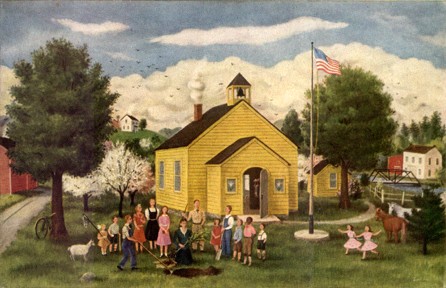 |
| A day at a frontier school. |
I love all types—I have three sets of hard-bound McGuffey's Readers,
Recently I received a number of CD’s containing what was entitled "The Eclectic Learning Series" published from the 1830's to the early 20th century in the mail from Dollar Homeschool. I was curious as to how user-friendly and useful these collected works would be for myself and others, so Aaron Jagt sent me a copy of the set so that I could review them.
Aaron has done a great job of putting a pretty comprehensive compilation of these old tomes together. I was pleasantly surprised to find much more was included than is listed on his website. Each disk was like opening a present at Christmas!
For instance, I wasn’t expecting to find sound recordings of lectures on the godly nature of mathematics. I can imagine hours sitting and listening to these while the children are sketching or doodling on a hot summer’s afternoon.
Also included is a series of books which attempt to teach grammar and composition through literature, using both copy work and dictation. I had just been researching such an approach among the free books online, so it was such a relief to find that one had already been included!
There is enough material in the history section for copy work, narration, timelines, etc. to last many years—including poetry.
I have become an enthusiast of 19th century learning materials because they were formulated and used during a time our society was greatly influenced by Biblical Christianity. Professor McGuffey himself was a Presbyterian minister. Also, to a great extent, these materials were created before many of the most radical “reforms” of Horace Mann and John Dewey were accepted "at-large" and implemented (although their eroding influence is evident even in the revised McGuffey readers of the 1880’s).
I get excited when we use these materials because of the clarity of thought, and the respect paid to the learner. No dumbed-down content here—economy was a necessity of the past, when paper and ink were precious, especially in the frontier schools. Each word, each number problem, was well-thought out and meaningful. The curricula of the age were free of “busy work”, making them just perfect for application in homeschools and tutoring programs where consistent, concentrated instruction is the preferred method.
I know many of these books are available for free online, but I also know the sites on which they are offered are not always reliable, and I have recently found it difficult to find many of the titles necessary for a well-rounded Eclectic Series education (discovering the entire set of revised McGuffey’s editions can be like chasing a snake through the grass). It can also be confusing with all of the different versions of each of the Ray’s Arithmetics, for instance. I could see spending a bit of money in order to own this compilation for the duration of my children’s homeschooling educational years.
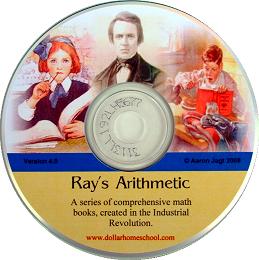
I did some figuring to help show the actual costs of these materials. I found there were 109 books total included in this package (if I have not missed any). This does not include the audio CD. If the asking price is $160, this makes the books cost approximately $1.47 each!
Of course, these are “digital” books—not easy to take to one’s room and study, unless you happen to have a number of computers for each child or a few of those nifty “reader” devices or an iPad. These devices would make the use of these excellent "digital" books much more “portable”.
For myself, I prefer to have the “tangible” form of books. I like turning pages and making places for more books on my library shelves. This is why I am planning on printing and binding a number of these books.
I figure that, on my little ink-jet, I should get about (700-800) pages per cartridge, that is using the “economical, black-only” setting. If I select "two-to-a-page" printing, this means I should be able to print about 15, 90-page books or seven to eight, 150-page books per cartridge (at $26 per cartridge). This makes it approximately $1.73 - 3.46 per book (or twice that for a three-hundred page book).
The paper is not very expensive, since I purchase it in ten-ream boxes from either Sam’s Club (free shipping) or a local office supply store where it was on sale (I noticed a ten-ream box on sale at Office Depot for about $25). This keeps my paper for a 90-page book (with the “two-pages-to-a-sheet” mode selected) at about $0.27!
Dollar Homeschool’s agreement states a person can print up to four copies of each book for personal use, which is plenty.
So here’s the breakdown in current prices for binding a 150-page book, using the “economy” and “Two-pages-per-sheet” settings:
$1.47—average cost of digital book
$3.46—ink
$0.54—paper
$2.00—comb-binding
$0.50—miscellaneous expenses
$7.97 per book! (or $0.03 - 0.05 per page)
This is such a frugal way to go, even if one has to put in a little “sweat-equity” in binding the books, especially when compared to other curriculum options. Even finding these materials is challenging.
These books are non-consumable, so they can be passed down from child-to-child, making this a one-time purchase for many years’ worth of learning.
I went on line and compared the costs of a popular mathematics curriculum to what’s included here—an entire elementary course in mathematics would cost upwards of $600—and then there would be the expense of replenishing some of the consumable workbooks required for the course.
Printing the books included on the Ray’s Arithmetics Dollar Homeschool CD, that is all 39 of them, would equal about $348 (and you probably wouldn’t want nor need to print out all 39).
Printing and binding all of the basic McGuffey readers, at the $0.03 - 0.05 per page rate, would cost approximately $51.94 - $84.30.
 For our little homeschool group, I am considering purchasing my own manual comb-binding apparatus. I am looking seriously at the Fellowes Star for about $55 on this site. It would make sense for us, since I love binding up books and booklets and should make it worth the initial investment in little or no time!
My oldest daughter is looking into the “click and print” option which is being offered by a number of printing houses. I will try and post her findings at a later date.
I am also considering printing up “booklets” of assigned material printed from the digitized books and catered to each child, which might include some note booking pages. In my thought processes are some extra practice booklets compiled from the White's and Dubb's math books. It would also be fun to create note booking pages for the Nature Study book.
It must be obvious that these materials would have to be supplemented with more up-to-date publications as well. A good set of encyclopedias and the Internet are a good start, and a library card would be a frugal way to round-out and complete a good education with these "digital" books as the foundation. Still, for the cost of just one year’s curriculum for one child, it is nice to own materials enough for many years (for example, Rod and Staff complete 1st grade, reading and math, costs $132)!
In case you feel as lost as I did when I began my homeschooling journey, Dollar Homeschool offers a Yahoo discussion forum with a number of archived discussions which helped me enormously when I began this review.
I do wish that the Manual of Methods was included on the McGuffey’s CD, as it really helps to clarify the use of these books in teaching reading—even takes one through the different methods in a more succinct way than I have ever read it expressed. I’m going to suggest this to Aaron Jagt so this may be changed in the near future.
If you are like me, prone to “creative meanderings”, then these materials are for you. Using these books allows me to enjoy my creative side, while giving me a basic structure that is sound and Biblically-based, free of a lot of the nonsense found in so many of the expensive alternatives of our present day.
My oldest daughter is looking into the “click and print” option which is being offered by a number of printing houses. I will try and post her findings at a later date.
I am also considering printing up “booklets” of assigned material printed from the digitized books and catered to each child, which might include some note booking pages. In my thought processes are some extra practice booklets compiled from the White's and Dubb's math books. It would also be fun to create note booking pages for the Nature Study book.
It must be obvious that these materials would have to be supplemented with more up-to-date publications as well. A good set of encyclopedias and the Internet are a good start, and a library card would be a frugal way to round-out and complete a good education with these "digital" books as the foundation. Still, for the cost of just one year’s curriculum for one child, it is nice to own materials enough for many years (for example, Rod and Staff complete 1st grade, reading and math, costs $132)!
In case you feel as lost as I did when I began my homeschooling journey, Dollar Homeschool offers a Yahoo discussion forum with a number of archived discussions which helped me enormously when I began this review.
I do wish that the Manual of Methods was included on the McGuffey’s CD, as it really helps to clarify the use of these books in teaching reading—even takes one through the different methods in a more succinct way than I have ever read it expressed. I’m going to suggest this to Aaron Jagt so this may be changed in the near future.
If you are like me, prone to “creative meanderings”, then these materials are for you. Using these books allows me to enjoy my creative side, while giving me a basic structure that is sound and Biblically-based, free of a lot of the nonsense found in so many of the expensive alternatives of our present day.
My Ray's Arithmetics and McGuffey's Primer Helps go perfectly with this set for teaching basic math and beginning phonics and reading!
Wednesday, June 1, 2011
Finding McGuffey on Our Homeschool Journey—guest post
Today's post is written by a guest and "McGuffey veteran":
 In 2006 when my daughter Natalie was finishing up her Traditional Textbook kindergarten curriculum I began to look for other cheaper options for homeschooling. That year we combined a textbook phonics, language arts and math with the Five in a Row book I found second hand. I just LOVED the literary education Natalie was getting. We had a blast reading great books, looking places up on our map, and doing crafts things to go along with it. Basically that year we did the workbooks, memorized some scripture and read! I look back fondly on that school year. The following year I looked into other high end curricula that followed the same literary bent. Since I couldn't afford that curriculum I began researching cheaper options. That's when I came across McGuffey's while researching Charlotte Mason.
 I loved the simple appeal of the books. Cute, moral stories with sweet pictures that weren't offensive to the intellect nor unappealing to the eye. That year we read them for fun! We ditched the textbook readers and just did McGuffey's with another workbook for phonics. I had discovered copy work by then so we alternated between a sentence or so of a McGuffey's lesson and the bible memory verses we were using. I did not know much about copy work at the time so I would pick a selection and write it out on paper making a space between lines for Natalie to copy underneath. I didn't pick out grammar or spelling nor did I do dictation. I just selected wonderful quotes, wrote them out and she copied.
A few years later when Natalie was in 2nd grade my son Logan began to use McGuffey much in the same way. We read them aloud, we read them silently, we read them for fun. We just enjoyed McGuffey! My son especially enjoyed the stories and often read them for fun.
This last school year a friend sent me a copy of Beechicks Parents Guide to the readers. I had read Beechick before and LOVED her ideas. Not being a teacher myself I had a hard time implementing them but for some reason this year it all clicked! So I began using McGuffey's again with my second son Benjamin. I'm still using other phonics and language arts programs at the moment but the more I get into McGuffey's with the help of Beechick, the more I understand how the Eclectic series really can replace your phonics, spelling, grammar and writing programs.
Usually what I do is sit down with my "student" and listen to them read or narrate what they have read. Natalie, age 9, would be narrating at this point from the second reader. Logan (8) and Benjamin (5 and an early reader) reading aloud from the first and primer readers. As I sit down and before they begin reading I quickly glance at my Parent guide and discuss anything she mentions or that I see needs mentioning. Things like phonics rules, vocabulary or new punctuation. I write those things on the white board and we make a word list (either for new phonics rules or for vocabulary) to write in our notebooks later. I listen to the lesson or narration and then we discuss the moral or idea in the lesson. Then I will assign the white board work to be copied in their notebooks and will assign another task to go deeper for them.

McGuffey's readers are such a great resource. I cant imagine why they took them out of the schools. Except maybe that they take a wee bit more time to use then say a ready to go workbook. We like them and find them a very useful and frugal addition to our school.
About the author:
![[th_main-7-1.jpg]](https://blogger.googleusercontent.com/img/b/R29vZ2xl/AVvXsEiwoAG_w7NXFmqGUpURo_2aO-BqxZV3DXDIU0x40UaNVU0SUX946JQ3fideNz4Ldn-9a4M_WTYO4MsEc5GH0qT1VZoHGrcdZjVMAEr3ibN3HFeGoNPeAE1aczhPUu6xf-4DxTEqxCGSiAE/s220/th_main-7-1.jpg)
Vicki is Mother of 6, Wifey to 1, Daughter of the King, keeper of the Home, and all around frugalista! (not in that order). You really should pop over to her blog,
Joy Homeliving, and read more!
Subscribe to:
Posts
(
Atom
)


