Thanks for visiting my blog, you can join me by subscribing

Monday, February 18, 2013

Using Ray's for Beginning Math

Mother teaches oral lessons
When one compares the primary Ray's Arithmetic with newer curricula, there seems to be a lot missing! The copy I am holding in my hand is only 94 pages long, which pales in comparison with modern books that cover the same material.

What is more incredible is that this tiny volume was meant to be used for two years!

So what is a modern teacher to do?

Here is a general course of action, as recommended in The Manual of Methods, which was written as a guide for the Eclectic Series (of which Ray's was a part):

  • Don't allow the children to use the book or to write at all at the beginning.
  • Use common objects, without using the number symbols.
Do not teach the figures in the first lessons, and do not allow the children to do any written work; but teach orally, illustrating every operation, at first, by means of various objects. Manual of methods, page 107
  • Practice counting common objects, then grouping them and having the children recognize them in groups without counting, such as seeing 3 blocks, 3 balls, 3 spoons, etc. Children should become able to recognize groups of up to 10 objects without counting them.
  • Show children how to group and re-group within a certain number, so that it will seem natural to think of, say, 5 as being 2 and 3, 4 and 1, etc. Also do the reverse actions, such as realizing that 5 take-away 3 leaves 2, and so on.
The instruction should be entirely oral, and should deal altogether at first with concrete numbers. The little child cannot grasp abstract ideas. It is true you can teach him to repeat, "2 and 2 are 4;" "2 from 4 leave 2:" "2 times 2 are 4;" and "4 divided by 2 equal 2." But, without the proper preliminary work, these words can not possibly convey any clear meaning to his mind. This kind of instruction in a primary class is simply machine drilling on abstract numbers and words which convey no ideas, or at best a mere jumble of ideas to the child's mind. It is one of the worst, and at the same time one of the most common, faults in the teaching of arithmetic, and it is one which is very apt to disgust pupils with the subject from the outset. On the other hand, if the proper method of teaching is pursued, which may properly be called the object method, the children are taught to think; they will be interested at the very beginning, and they will be kept interested by this method until they are successfully carried to the point where the object method is no longer necessary, and their minds are ready to grasp the abstract, through careful preliminary drill on the concrete. Manual of Methods, pages 107-108

I have created flash cards in my Ray's Helps that illustrate these principles, one set without numbers, the other one with numbers, that can be printed out and used to aid a parent in this endeavor.

  • Then, and only then, begin to introduce the actual number symbols.
Teach the concrete digital numbers in regular order, from one to ten inclusive, illustrating each number by corresponding groups of objects. Manual of Methods, page 108.
It is important to realize that there are only ten written digits, and that these ten alone make up our whole number system! If we can approach this task from this perspective, things become a little more clear to our minds, and we can encourage our children that math is not that difficult, after all!

This beginning, if done in increments of only 10-15 minutes a day, should cover a number of months!

This is not complicated, not dreary, not time-consuming. My suggestion is to take a small basket and fill it with what you will need--some counters, which could be marbles, beans, pasta shapes, etc., and some flash cards. Eventually a small chalk or wipe-off board could be added, as objects and numbers are drawn, and then the child may draw objects, circle things, and eventually begin to write the numbers. 

Remember, this method was formulated for the one-room schoolhouse. A teacher in such a setting had to manage the education of a number of students in various stages of learning. I have read over and over that the Ray's method is extremely "labor intensive," but I have found the opposite to be true. Of course, if one is expecting a child to be able to grab a workbook and study without any help whatsoever, then this will not fit the bill--but I have yet to meet a child that did not require any instruction whatsoever! But Ray's only takes 15- 20 minutes a day, especially in the beginning years. For a very busy mother, this could be carried out just before bedtime, if necessary! Think of working for 15 minutes on counting, etc., then reading a nice story, saying a prayer, and kissing your babe goodnight! That is it--no muss, no fuss! And, for the real secret, as you are teaching your eldest child, the other tiny ones can be included, meaning that you will have less work to do as you go along... 

Even the next stage should not become a burden.

After a child has become very confident in the above described knowledge, two things should then happen. First, a 100 numbers board should be introduced. This is such a great tool! You can find numerous of these to print out for free on the Internet, the most frequented being the Donna Young site. You should have on printed out and either laminated or placed in a plastic protective sheet. Then the fun begins!

There are so many things that can be done with such a chart that I have collected some sites that list them:

20+ Things to Do With a Hundreds Chart

The Wonders of the Number Chart

A hundred chart looks deceptively simple, but complex understandings can be developed by using one. On it children can learn to count, and to consider prime numbers, and everything in between. Use the chart often enough that children will carry its image in their minds for years--for as long as they need it, which may be a lifetime or at leas until they are so far into abstract thinking that they don't need the image anymore. Ruth Beechick, You Can Teach Your Child Successfully, Mott Media
Begin with simply counting to ten for a few days if necessary, then quizzing the student and having him find a number as you call it out. Do the same to 20, then by 10's, then to 100. After this is mastered, you are ready to introduce a number of the other fun games.

As you are exploring this avenue, then begin to work through the text. There is a bit of confusion here concerning the first lessons. It needs to be understood that formal math instruction was not begun in most schools during this time until a child was already reading--in fact, math was often delayed until the ages of 9 or 10. If you are working with a pre-reader, or a struggling reader, then you might want to skip to lesson V and VI, and proceed from there. 

Lessons VII-IX are good just as an initiation. Lessons X-XX could be done in this way; read through the math facts and the lesson, asking questions and, if necessary, using objects to illustrate the different principles. Each day afterwards, read the facts out loud and have the child repeat them. After a number of days, ask the child to recite them from memory, helping at first. When mastery is achieved, go over the questions in the text once more. Lessons XXI and XXII are good for extra practice in mental exercise and review of the previous facts learned. These review lessons could take a number of days--no need to hurry through them!

In this same way, the first 37 lessons can be covered. This is meant to be the first entire year of study!
...for more excellent results, you should faithfully follow the mental system in Ray's Arithmetics. Avoid the temptation to hurry the children into writing rows and rows of problems so you can put them to work and take a recess. many children are better off not starting formal arithmetic study quite so early as our society tends to think. So, particularly in a home school setting or small one-room school, you can use real-life situations, manipulative objects, and games to help children develop in their understanding of numbers. Relax and take things at the children's pace. Ruth Beechick, from the Parent-Teacher Guide for Ray's New Arithmetics, published by Mott Media.
Feel free to have fun with all sorts of games, flash cards, etc. You are building a foundation here that will help your child, not only to master math, but to enjoy it!

Of course, for fun and reinforcement, other things can be added. We like the Rod and Staff  books for coloring and counting fun, as well as other practice. Each workbook is only $2.95, which is very reasonable.

After Ray's Primary Arithmetic is completed, then it is best to move on to Ray's Intellectual, but that is for another post, since this one was to answer questions about beginners!

Here are the wonderful ways to obtain your own copy of this wonderful book: 

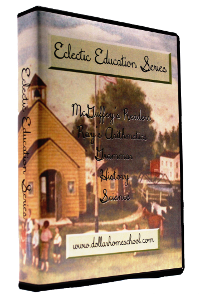
Dollar Homeschool. This is a collection of all of the Eclectic Series textbooks, including Ray's and all of its complimentary resources, such as teacher's manuals, etc. which have been scanned in and put on DVD. Having all of these delightful works together in one place was so helpful that I just had to write guides so that others could enjoy them, and these guides are now included! 

Mott Media. These folks have reproduced hard-bound copies of the original McGuffey's and the "new" Ray's, and also offer guides written by Ruth Beechick along with consumable workbooks to go along with the series (which I have never used).

There are others which offer hard-copies of the McGuffey's, usually the revised series (1880 or so). Amazon is also a great source.

Of course, there are numerous ways to obtain these books online for free, and Internet Archive is the fastest way I know of to find all sources at once.

I would also strongly suggest reading Ruth Beechick's guides on teaching at the elementary stage, as are listed on the Mott Media site.


Above is a poster page that will serve as a reminder of the ideas suggested in this post. Just click and save the image to your computer, perhaps pasting it into a word-type page and printing it out. 


Sunday, February 10, 2013

Saturday, February 2, 2013

Caring for Yourself?


Ever wonder how to keep your life in balance?
Where the Spirit is made new through Christ, the mind, will, and emotions all benefit, and, as the person moves from milk to meat, all is brought into balance. Then there is a health that radiates and beautifies.
For more, follow me over to Raising Homemakers, where I reveal the "self" secrets of a godly mother...

Tuesday, January 29, 2013

The Art of Self-Education


There is a certain mentality that sets pioneers apart. They are not afraid of change or challenge, and they always live in expectation that there will be a blessing at the end of their journey.

They also don't have much patience for wasteful pretense, vanity, or for the "book-learned" individual that has not earned his stripes through real-life application.

When a genuine pioneer sets out to learn something, it's purposeful. There isn't any time or space for sitting around to ponder for pride's sake; no exalted "food for thought" for fools or jesters, or for drifting aimlessly and ending up in the puffed-up regions of one's own mind. Spirituality is more concrete than abstract; God's existence is a given, and time spent in spiritual pursuits is all about knowing Him and serving Him just as He has asked, not about why He does or doesn't do things or any of that other cosmic-consciousness nonsense. 

Pioneers don't think much about education, they just live it. If they need to acquire some knowledge, they do what it takes to seek it out. They knock on doors and walk miles, if necessary, to gain every bit of understanding they need to accomplish the task that is fervent in their hearts. They spend hours in observing, and more hours in "cogitating" until concrete pictures begin to form in their minds and fill their dreams at night.

Even though it seems as though the whole earth has been conquered, we still need the stalwart and the brave; the thinkers to whom there are no boundaries. They are being born every day, we just need to stand aside and give them room to step out of the crowd.


In order to do this best, we need to give way to true education, which has never been about mice running through a maze to get a reward, but about learning things simply because they are necessary for living, exploring, creating and blessing others.

The system we have put in place is not about nourishing healthy minds, but about giving them Hostess Twinkies instead of steak and potatoes. They step up to the vending machines we call public schools and then press the appropriate buttons until we pronounce them "educated," but their minds are filled with empty conceit or a dread of a hopeless future.

Then we tell them to "grow up," and they stare blankly.

Homeschoolers know this, and this is why we are so very dangerous. In place of teaching our dear children how to circumnavigate around God's wisdom, we let them dive in, head first, and swim in it until they are filled, covered and immersed completely

In place of mere facts, we offer them ideals. Instead of "requirements," we give them true direction. Rather than a prefabricated world, we introduce them to the tools with which to create their own.

We don't sanction for original thought, we welcome it. We allow them the time, or even slow the pace, so that their thoughts can honestly take shape and solidify without the constant rapping of a thousand nonsensical commercials beckoning them to chase after every rabbit-trail and pipe-dream.

And when our work is done, we step back, and we watch, and the world wonders, and is blessed, by what God has wrought through our children.


Sunday, January 27, 2013

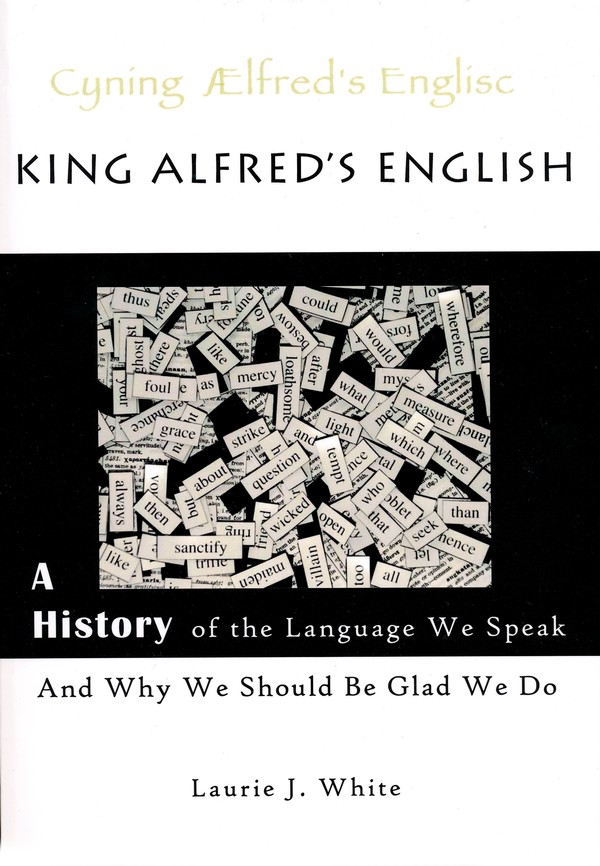
King Alfred's English

Language study is a hobby of sorts for me. Besides looking up the definition of a word, my spaghetti-brain will often get me lost on some outrageous rabbit trail to find its origins...sometimes I get so wrapped-up in the pursuit that I forget what word I was originally looking up!

This is why, as soon as I saw it recommended on Good Reads, I just had to get my hands on a copy of King Alfred's English, written by Laurie J. White.

It took me about 6 weeks before it was available from the library, but it was worth the wait!

This is not another snooty, dry textbook on the origins of our language, but reads like a novel that is hard to put down! This is the type of book that demands that I find "free-time" to read it!

Laurie is a Believer in Christ, and so her history is full of references to the workings of Christianity throughout the history covered in her book. She even focuses on how the King James translation of the Bible came into being.

Besides this, she has a website that offers a timeline that is so amazingly wonderful I just had to mention it! Her Pack of Tricks is also quite amazing! (there is even a teacher's page with worksheets and tests)

Even though I am able to read this book for free from the library, I am putting it on my prayer list as a "must have," worth every penny I could spend for the education of my children here at home!

If you have a child (or children) who consider spelling and grammar, or even history, "boring," just sit them down and read this book with them--you'll not only be engrossed from the very first page, but you will even find yourself laughing in places!

*At the writing of this post I did not receive any special consideration in any form from the writer or publisher of this book--I just liked it so much I had to share!


Wednesday, January 23, 2013

Thursday, January 17, 2013

Lilla Rose Party; Beauty and Modesty with Sarah


Sarah Elizabeth
Today I am going to interview my sweet daughter, Sarah, who is very interested in beautiful, modest fashion for women and young ladies.

Me: Sarah, tell our audience just why you are so interested in what we ladies look like on the outside? 

Sarah: I've always been pretty "girlie," but in a way I think it's a duty to look pretty and modest at the same time for all who have to see us all day long! When we don't care about our personal appearance, people will get the impression that we don't care about anything else. It's very selfish not to realize just how beautiful and feminine God has made us! 

Me: When you think of the word "modest," what comes to your mind? 

Sarah:  To me modesty has to do with sweetness, at least in my mind. How you dress should display the sweetness and innocence you have on the inside. It's a way of expressing how you are "covered" and how God is protecting you. 

Nicole takes a country stroll
Me: In our modern day, what are some things we can do to be both "beautiful" and modest at the same time? 

Sarah: Skirts and dresses are a part of that protection and covering I mentioned, because they do an excellent job not to reveal everything about our bodies. They are beautiful and practical at the same time. You can do a lot of things with skirts. You can layer, embellish and accessorize so that you look good for every occasion, and even appear dressed-up in order to make your family feel special no matter what you are doing! You should dress very nice each and every day, and skirts really add dignity to everything. 

Me: How does hair, personal hygiene, and even make-up fit into your views on beauty and modesty? 

Sarah: Let's begin with our hair. Some people can go really crazy with it--like making a mess out of your hair--that's just really weird! But the Bible says that a woman's hair is her glory, that means that we are glorifying God by fixing our hair and making it look as lovely as we possibly can without over-doing it.

Me: What are some of the things you do to make your own hair look lovely? 

Sarah: Well, I like to braid my hair, and you can often find me wearing ribbons or even hair accessories (Lilla Rose has some really terrific ones). I have naturally straight hair, which I know is the current fashion, but I still love to curl my hair. I really don't pay attention to the current trends, but instead, I try to dress and do my hair in a way that looks good to me. 

Me: What about personal hygiene and make-up? 

Sarah: I'm a morning person, so I get up earlier than almost everyone in my home and go through my morning routine; first I wash my face (I actually use lotion to wash my face, because it moisturizes as it cleans), thoroughly brush my teeth, put my make-up on and style my hair. This usually takes me about half of an hour altogether. 

Me: What kind of make-up do you consider necessary and why? 

Sarah: Some ladies don't wear make-up because they want to honor their fathers or husbands. My dad appreciates a little make-up on ladies, so this is fine in our home. I feel that mascara, some foundation powder, a small amount of blush, occasionally some eye-shadow and a little bit of lip gloss are appropriate. I try not to put it on too thick, because the idea is to enhance, not to give yourself a whole, new face! 

Me: What are some other things you would like to say on the subject? 

Sarah: Jewelry! Some folks feel that it's not proper to wear any jewelry at all. It can be OK, as long as you are very careful about what you wear, and make sure that you are not obsessed with it or over doing it. I put on just enough accessories to complement what I am wearing, but not so much that people are blinded, or distracted by what I wear! 
Me with a Lilla Rose clip

Also, in Proverb's 31 we find that a good woman actually tries to clothe herself well, so caring about what we wear in order to look nice and appropriate can't be sinful! 

Me: Thanks, Sarah, you know, you don't have to do a thing, you have always been so beautiful to me! 

Now, for that Lilla Rose party!

My friend, Heather Mason, is allowing me to invite all of you to participate in some really special deals beginning right now Thursday night, January 17, 2013 through next Friday, January 25, 2013. 

Heather is a large family mom, and is also quite an entrepreneur, just like that Proverbs 31 woman! I love promoting her business and helping my readers at the same time (and now, first-time buyers who order three clips can order a fourth one free!) 

Also, this Friday, tomorrow, Lilla Rose is offering a one-day discount on their three newest clips!


Here is the portal to the party (FYI--who ever orders during this party event will be automatically entered to win a FREE Lilla Rose Clip!):